
Author: Maxime Chautemps
Editor: Haytham Malik
Artist: Suzie Mishima
Have you ever wanted to watch life evolve? Have you ever speculated on how different certain species might look or behave had conditions varied even a little bit somewhere in their evolutionary past? The Sapling is an indie video game that attempts to do just that: simulate life and how it evolves. I interviewed its developer, Wessel Stoop, to find out more.
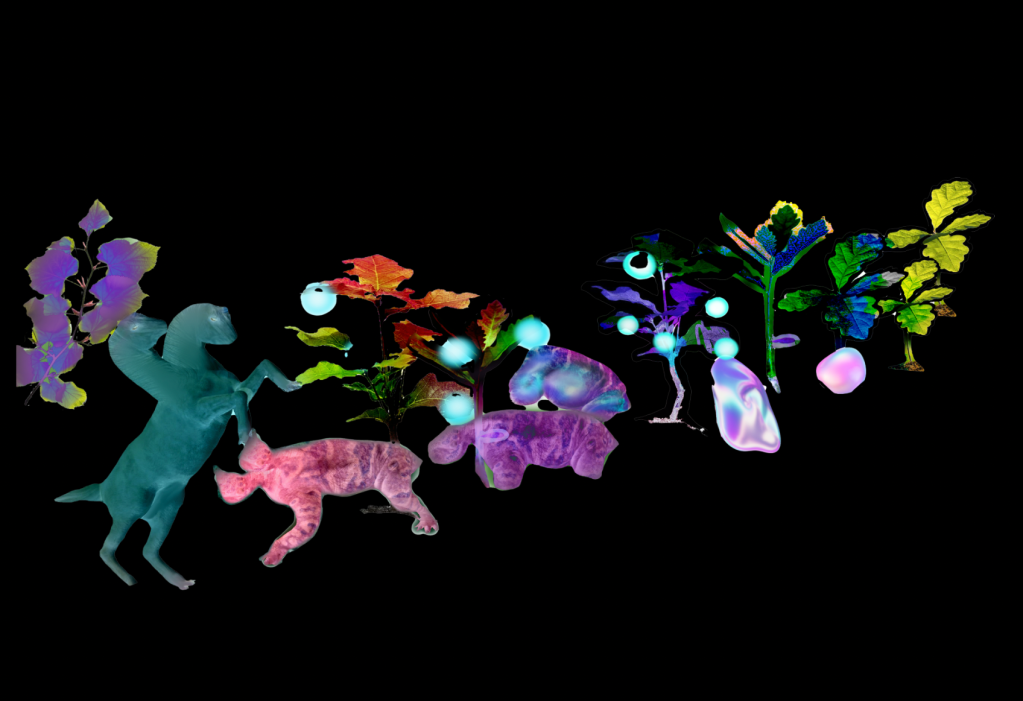
The game currently has four groups of organisms: algae, plants, animals, and, after the most recent update, fungi. “You create them yourself, and you can create your own ecosystems,” Wessel tells me. “Or you can hit the random mutations button, let the game run for itself, and see what happens.”
Wessel first had the idea for a game like The Sapling when he was around eleven years old. For as long as he can remember, he’s been playing simulation games and fantasising about making his own. “If you’re in that mindset—you like simulation games and you want to make simulation games—everything around you, any system that you see, you think, oh wow, cool! Somebody should make a cool simulation game about this!”
I am a little bit shocked when he tells me that his interest in nature is relatively new by comparison, but once he explains why, it all makes sense. “Evolution was always the starting point of my interest,” he elaborates, “and only from there I’ve also grown interested in nature.” For Wessel then, “the core interest is this mechanic—the evolution mechanic.”
So how does evolution work in the game? And how accurate has Wessel managed to make it? “It’s not that complicated at all, actually”, Wessel says. He points out that there are similar games that use a system much closer to DNA than his own. The Sapling doesn’t work like that, and the reason why comes down to a question that Wessel is constantly asking himself: how much can be simplified?
Organisms are divided into body parts, each of which has a chance of randomly mutating in offspring depending on what mutation rate the player chooses. The computer then rolls some dice to decide which body part will change and how it will change, with mutations affecting colour, size, morphology, and more. Animals can even develop instincts allowing them to respond to stimuli or randomised hormones that affect their behaviours.
Wessel’s approach to The Sapling has been shaped by years of playtesting and direct feedback from the game’s passionate fanbase. “One of my design principles is that whatever I’m building, it should be something I can visualise, something I can show to the users.” This became especially clear to Wessel in the early days, when a lacklustre launch left the future of the project uncertain. Four years later, it is clear Wessel has found his confidence in navigating how to make the game accessible and enjoyable to a general audience. This is a challenge that should not go unnoticed when it comes to trying to simulate a system as complex as evolution.
A large proportion of The Sapling’s community are themselves involved in biology, whether through academia, work, or as a hobby. Despite having to often sacrifice realism and accuracy in favour of playability, this group in the community seem to be the most devoted and understanding of the limits the game has to work within. “It seems like everybody understands that you can’t get everything right, because then your computer would explode.”
Still, feedback from players is vital for The Sapling, and ensuring as much realism makes it through is always a top priority. “It’s important to get all these details right, because I’ve noticed that the audience appreciates it when I do.” To do so, Wessel reads through a bombardment of daily suggestions, coupled with dense research. Due to his background in linguistics and game development, Wessel jokingly tells me how, “my wife sometimes makes fun of me when I’m reading scientific papers about, for example, how algae connect to the ocean floor and all the details around that; that’s something she never expected me to read.”
With the increasing role of video games in education, the potential for simulators of biological systems as learning resources has never been greater. The Sapling itself has apparently been recognised as such, with Wessel explaining how teachers have reached out in the past. “Almost by accident, it’s something that teaches stuff to people. That was not my intention at all – it was just my geeky interest that I turned into a video game.”
All learning resources have their limitations—video games are particularly vulnerable to distracting from potential learning material – and The Sapling is no exception. “There are some facts that the game does not get correct, and then I’m worried that maybe these biology students will learn stuff about the world that is not actually the case.”
Nonetheless, The Sapling has evolved dramatically over the past four years. It is one of many games attempting to simulate evolution and ecosystems – all inheritors of a legacy stretching back thirty years to projects like PolyWorld and Creatures.
With a new update on the horizon that promises to add features ranging from fungi to sexual selection, The Sapling shows no sign of stopping yet. “For now, as long as I remain excited about this project and the audience remains excited about this project, I’m going to keep going.”
 Kinesis Magazine