
Author: Chloe Lum Sum Yi
Editor: Haonan Liu
Artist: Yasmin Yong
What Determines Cuteness?
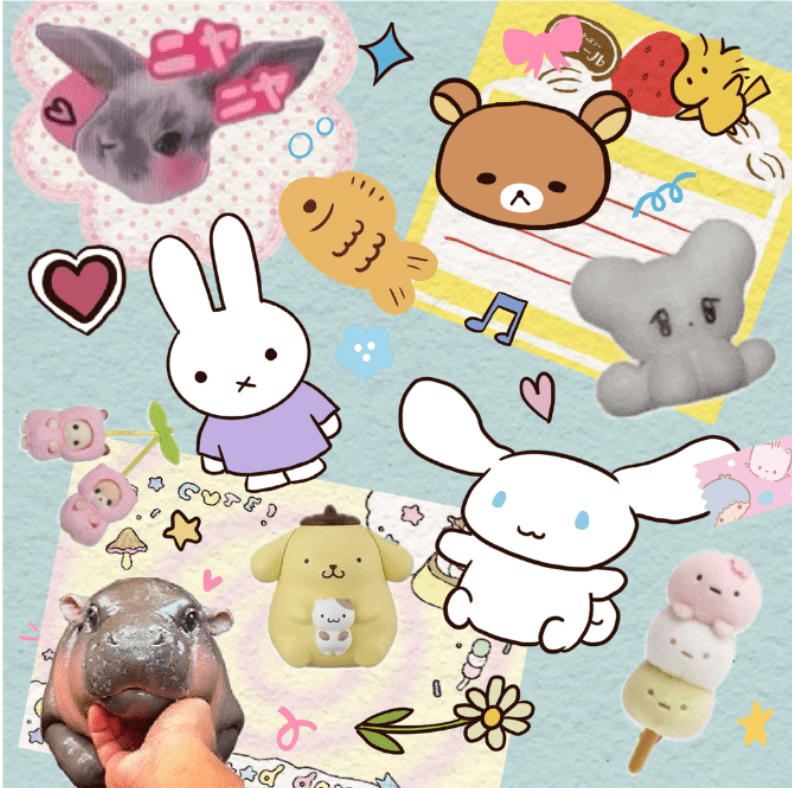
The term Kindchenschema, or baby schema, was first coined by ethologist Konrad Lorenz, who observed that some characteristics of infants—such as big, round eyes, a small mouth and nose, a relatively large head, and soft, rounded body shapes—are universally regarded as “cute”. This depiction is not limited to human infants; animals, cartoon characters, and even inanimate objects like plush toys and figurines are bred and designed with these “cute” features to elicit the same attraction.
Cuteness is a multisensory experience that can be evoked by touch, sound, and smell, in addition to visual beauty. Take the Australian king penguin, Pesto, for example. Pesto, who weighs 22 kg and is 9 months old, has large eyes compared to his head. The fun, relatable charm that makes him unquestionably “cute” is a result of his fluffy, spherical form and adorable, infantile actions, such as tilting his head curiously and chirping while attentively following his carers.
Furthermore, as the adored Grumpy Cat (also known as Tardar Sauce) demonstrates, cuteness may transcend conventional indicators. Due to feline dwarfism and an underbite, she had a scowling face that was different from the conventional feline proportions. Her huge eyes, downturned lips, and prominent brows caused a constant frown. Instead, we are able to project human emotional expressions onto her because of her peculiarly cranky manner, which makes her sympathetic and simple to anthropomorphise. Grumpy Cat’s appeal highlights how adaptable our sense of “cute” is, drawn to both conventional traits and unusual qualities that evoke affection—cuteness is ultimately in the eye of the beholder!
How Cuteness Engages Our Minds
Our brains experience rapid and intense activity when we come across something that is unquestionably cute. In areas such as the orbitofrontal cortex, dopamine and oxytocin – neurotransmitters associated with pleasure and emotional connection – are released as a result of this reaction. According to neuroimaging research, when we view a baby-like face, the orbitofrontal cortex activates in 140 milliseconds, or a split second.
Yet cuteness does more than simply grab our attention; it holds it. This initial response leads to more sustained processing across larger brain networks, including the fusiform face area, which specialises in face recognition. Professor Kringelbach, a neuroscience expert at the University of Oxford, points out that when we gaze at babies or anything with baby-like features, we see synchronised activity in both the orbitofrontal cortex and the fusiform face area. These areas work together to make sure that cuteness grabs our interest and emotions, which results in a lasting reaction that strengthens our natural need to care for and protect.
Interestingly, this phenomenon is not limited to parents; studies show that men and women react similarly to adorable features, and even children reciprocate. Therefore, cuteness is also an evolutionary adaptation: it evokes a sense of smallness and vulnerability, triggering innate caregiving, nurturing, and protective behaviour to improve the likelihood of species survival.
But have you ever felt the urge to squeeze something adorable almost too tightly? Known as “cuteness aggression,” this odd behaviour may seem counterintuitive, but it is a typical reaction to intense affection. Cute aggression is a prime example of dimorphous expression, in which someone feels one emotion but outwardly expresses another. Dr. Aragón, psychologist and accomplished researcher in neuroscience, claims that this might occur during a range of emotional experiences, such as crying during good times or laughing during sad ones. Our responses, however, can become even more nuanced and conflicting when presented with adorable stimuli. She suggests that dimorphous aggression serves as an evolutionary mechanism to regulate overwhelming positive emotions and maintain functional caregiving.
Cuteness Crusade: Every Species Deserves Love!
Because cuteness is a strong emotional catalyst for compassion and empathy, it is gaining traction as a potential tool in conservation science, effectively fostering public interest and support for endangered species by appealing to our natural instincts to nurture and protect.
Moo Deng (Thai for “bouncy pig”), a baby pygmy hippo, illustrates how cuteness can drive conservation efforts. Her spirited antics—swimming in water and nibbling on her zookeeper—have made her an online sensation, doubling visitor numbers at Thailand’s Khao Kheow Open Zoo. Zookeeper Atthapon Nundee’s social media posts about Moo Deng have sparked a strong emotional connection with audiences, raising awareness for the endangered pygmy hippo, of which only 2,000 to 2,500 mature individuals remain, according to the IUCN Red List.
However, as aesthetics play an increasingly crucial role in attracting the attention of conservationists and researchers, often only a limited number of endangered mammals—usually the more visually appealing ones—receive funding and support. How do we protect creatures that are viewed as unsightly, frightening, or “ugly”?
In the same way that films like Ratatouille (2007) and Zootopia (2016) have made animals who are frequently viewed as pests into endearing characters, direct exposure to these species can aid in altering perceptions. Similarly, groups like the Ugly Animal Preservation Society (UAPS) combat this prejudice by utilising comedy and humour to increase public awareness of endangered and fragile species that are frequently disregarded because of their looks. Additionally, they frequently elect “ugly” mascots through public voting.
From 1970 to 2020, the number of 5,495 vertebrate species fell by an astounding 73%, according to the Living Planet Report 2024. Human activity is also responsible for extinction rates that are tens to hundreds of times higher. This pressing issue, which is fuelled by hunting, pollution, habitat loss, and climate change, emphasises the need for more financing and outreach for conservation. Conservation research can engage the public and create support for endangered species across the aesthetic spectrum by appealing to the deep empathy and compassion that cuteness evokes, ultimately resulting in more impactful conservation efforts.
 Kinesis Magazine