
Author: Ayotenu Dosumu
Editor: Amelia Shen
Artist: Ahmad Bilal
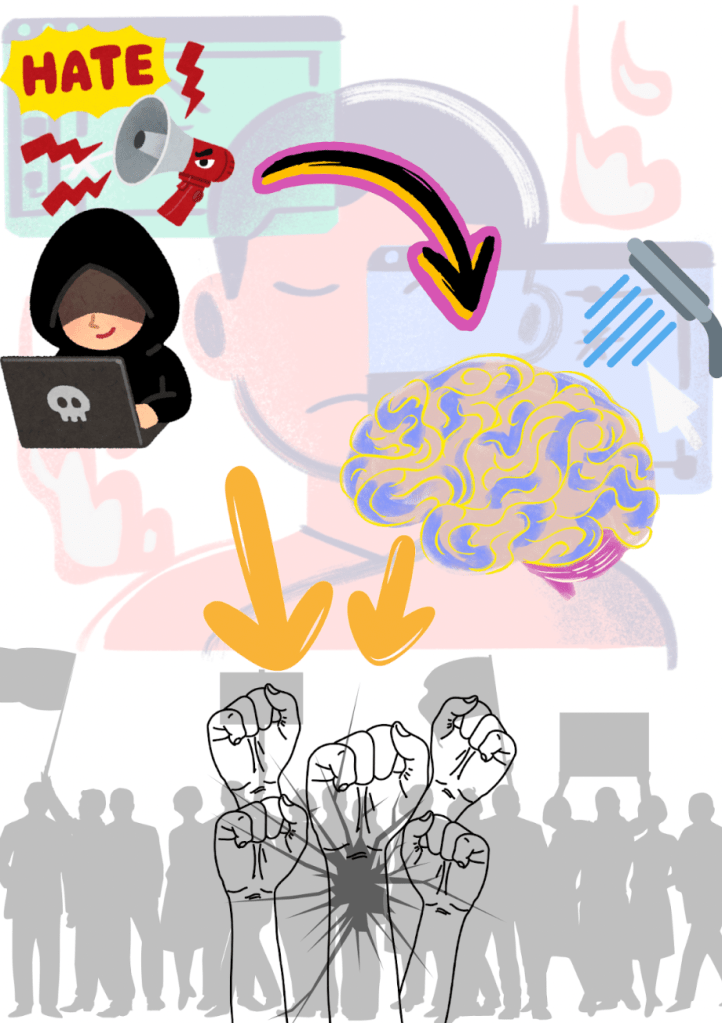
How can soldiers carry out atrocities and sleep easy? How can people blindly follow internet personalities and do their bidding? How can those we consider thoughtful friends and kind colleagues demonise and hurt vulnerable communities AND truly believe that what they are doing is right? The term brainwashing comes to mind, a word that is casually thrown around but complex in nature and implication, as it operates at the intersection of political authority and religious doctrine.
Taylor (2016), in her book “Brainwashing: The Science of Thought Control” describes brainwashing as: “The dream of controlling other people’s beliefs and behaviour so effectively that they do not feel manipulated – as if the imposed beliefs were their own”.
When brainwashing an individual, the aim is to: Isolate victims from their previous environment; control what they perceive, think, and do; increase uncertainty about previous beliefs; instil new beliefs through repetition; use emotion to weaken former beliefs and strengthen new ones. In today’s current political climate, where there is ever growing distrust in political structures and leaders, more and more people are angry and frustrated. Thus, they find themselves more susceptible to extreme beliefs “presented by someone they feel is on their side” – someone they trust.
Belief and Behaviour
A schema is a set of beliefs, attitudes, and behaviours; patterns of thinking that allow people to interpret the world. In this context, schemas can be considered personas we adopt in different situations. Different schemas can contain opposing beliefs, but this incompatibility will not be noticed by the individual unless a situation activates two schemas simultaneously, meaning the individual will not notice the hypocrisy in their own behaviour.
Different schemas are represented by different patterns of connections between neurons. In the brain, different aspects of the world are encoded by individual neurons (this is known as abstraction), hence it is the activation of a group of neurons that encodes for the entirety of an experience, object or belief.
These connections are strengthened when neurons are activated at the same time and more frequently (repetition). Taylor explains, the stronger (better learned) a schema, the more it defines self-identity and resists change. They are used more frequently and without conscious thought, and when these schemas are altered an identity shift may be perceived. Furthermore, when altered by external influences the individual may be perceived as “brainwashed”.
Misinformation and Memory
Another aspect to consider is the effect of misinformation on memory and beliefs. Memory of events can be distorted by misleading post-event information resulting in individuals claiming to remember events and news stories that are inauthentic. The latter is aided by the inclusion of deepfake videos with the presentation of the fake news.
However, memories of an event cannot be completely overwritten and are resistant to complete unlearning. When individuals are warned about the unreliability of information they have digested, they are less likely to fall prey to the effect of misinformation on memory and contrived beliefs. But they are not completely safe! The Continued Influence Effect indicates that misinformation can still influence beliefs and judgements even after being corrected, with belief in the misinformation persisting, despite remembering the correction. This effect can be applied in the context of political orientation, where individuals are more likely to believe misinformation that already aligns with their political beliefs.
Reducing Susceptibility
Individuals most at risk of brainwashing are those struggling with a sense of identity and belonging. A person seeking to radicalise these individuals will pose as a friend and provide an environment where extreme beliefs are reinforced and not challenged, leading to changes in a person’s schema. But the effects of brainwashing are reversed once the “new identity” stops being reinforced.
Throughout this article brainwashing has revealed itself more so to be intense social coercion than “mind control”. In order to combat this, we must simply “Stop and Think”. Taylor explains, people must employ critical thinking, scepticism and humour when analysing messaging. Is the logic sound? How is emotive language being used? How accurate are the facts being presented? What is the motive of the message’s source?
Ultimately, brainwashing is a social and political phenomenon. In order to prevent it at a societal level, people must support political stances that value individual human life above select societal groups.
 Kinesis Magazine