
Author: Madeleine Hjelt
Editor: Amy Whiting
Artist: Bella Marwick
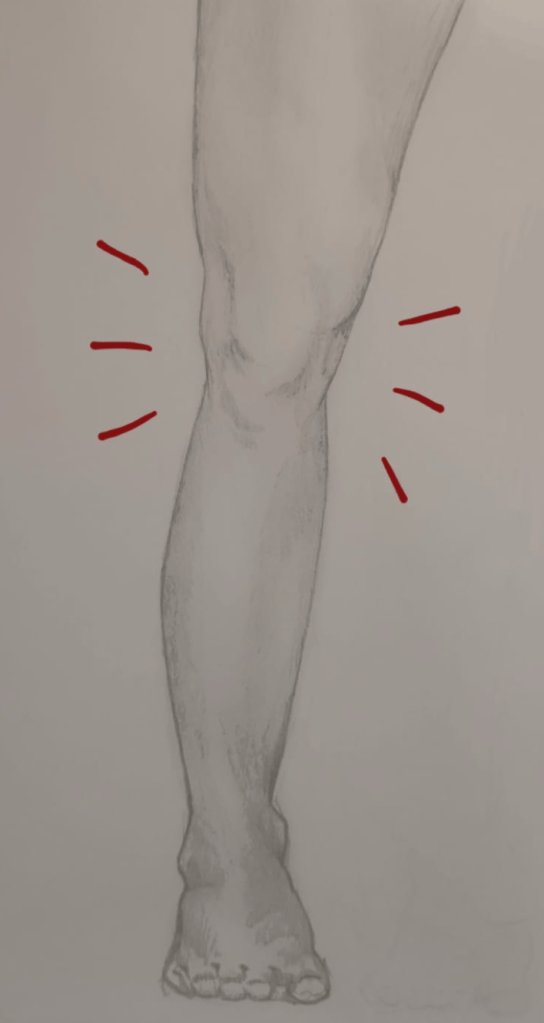
I am currently on crutches, still dealing with a knee injury that happened almost two years ago. To give you some context, I was walking nearly normally within a month of the injury, with only mild pain. So, what went wrong?
Back in February 2023, I went skiing, returning with a fractured knee after a fall and a sudden twist to the joint. I walked with a painful limp and could not fully extend my leg for a week, yet I kept walking on it, assuming it was a bruise that would fade. Three weeks later I had an MRI, showing bone bruising to the lateral femoral condyle and posterior lateral tibial plateau and an impact subchondral fracture at the peripheral margin. In layman’s terms, my knee had taken quite a beating, resulting in spectacular bone bruising and a small fracture at the point of impact. At the time I was 19, with no previous knee injuries and in good physical health. Seems like a simple recovery, right?
Well, bone bruising is notorious for its lengthy healing time, especially surrounding the knee, where blood supply is poor. Since healing requires a steady flow of oxygen and immune cells, the low blood supply around the knee can significantly slow down the process. When the bone bruises, fluid or blood accumulates in the marrow, often taking months to clear up. For me, it took over six months.
Four months post-injury I had assumed it was completely healed, as I had no pain and was back to all of my regular activities. So, I made the wise decision to jet off to Barcelona, where I walked 30,000 steps, three days in a row. My bone bruising flared up, my joint swelled and I was in significant pain. Maybe I should not have gone clubbing that final day.
That was my first re-aggravation of many, each time taking longer and requiring more effort to heal. My knee had entered a positive feedback loop of pain, swelling, and ligament laxity. When a joint is in pain, it causes swelling, which causes ligaments to loosen, leading to joint instability. Unstable joints cause more pain and, therefore, swelling.
To make things more complicated, I was born with Generalised Joint Hypermobility (GJH), meaning my ligaments are naturally loose, especially in my knees and elbows, due to a defect in type I collagen in my connective tissues. Hypermobility affects one in four people, however many are unaware of its long-term implications. The main symptom is greater flexibility – my joints bend beyond the average range of motion – but it comes with downsides. While GJH offers benefits like softer skin and even fewer wrinkles as we age, it is also associated with issues such as frequent joint dislocations, fatigue, and digestive problems. Hypermobile individuals also face muscle weaknesses linked to joint instability, so their muscles must work harder to compensate for weaker joints. Over time, this increased demand places additional strain on the joints, particularly the knees, elevating the risk of osteoarthritis.
The knee, in particular, is highly vulnerable to stress from activities like walking, standing, and jumping. It is the body’s most complex joint, relying on ten different muscles for support, and is one of the joints most affected by osteoarthritis. Knee replacements are among the most common surgeries in the U.S., with approximately 850,000 performed annually.
From an evolutionary perspective, the human knee had to adapt rapidly when our ancestors became bipedal around 2-2.5 million years ago (Mya). This transition, which took only about 0.5 million years, required our knees to quickly adjust to carrying greater weight on two limbs instead of four. Adaptations like aligning the knees closer to the body’s centre and increasing joint surface area for muscle attachment helped manage the increased load. Despite these changes, knee issues are very common today, likely because our ancestors – who had shorter lifespans – rarely lived long enough to experience age-related joint problems like osteoarthritis. In modern life, therefore, it is essential to adopt strategies that preserve knee joint health and delay the onset of degenerative conditions like osteoarthritis.
For people with hypermobile knees, maintaining joint stability requires even more muscle engagement from the quadriceps, hamstrings, and calves. This increased demand can lead to muscle fatigue and weakness, making hypermobile joints more prone to injury. Low-impact exercises like cycling and swimming are ideal for building strength without stressing the knee joint. In particular, treading water is fantastic for strengthening all leg muscles, including the gluteus maximus. A story from my physiotherapist convinced me to give it a go when she told me one of her patients, a pole dancer, relied on it to increase leg muscle strength.
Keeping your joints healthy is crucial – especially in your younger years – to set yourself up for a long and active life. Despite the adaptations that evolved with bipedalism, the joints’ complex structure and their role in supporting body weight make them especially vulnerable. Hypermobility, a commonly overlooked condition, can lead to debilitating injuries and an increased risk of osteoarthritis if not managed properly. Recovery from these injuries can be long and challenging, so take it from me: do your physio and let your injuries recover fully, especially if you are young and hypermobile!
 Kinesis Magazine