
Author: Amber Stratton
Editor: Mhairi McCulloch
Artist: Naomi Chung
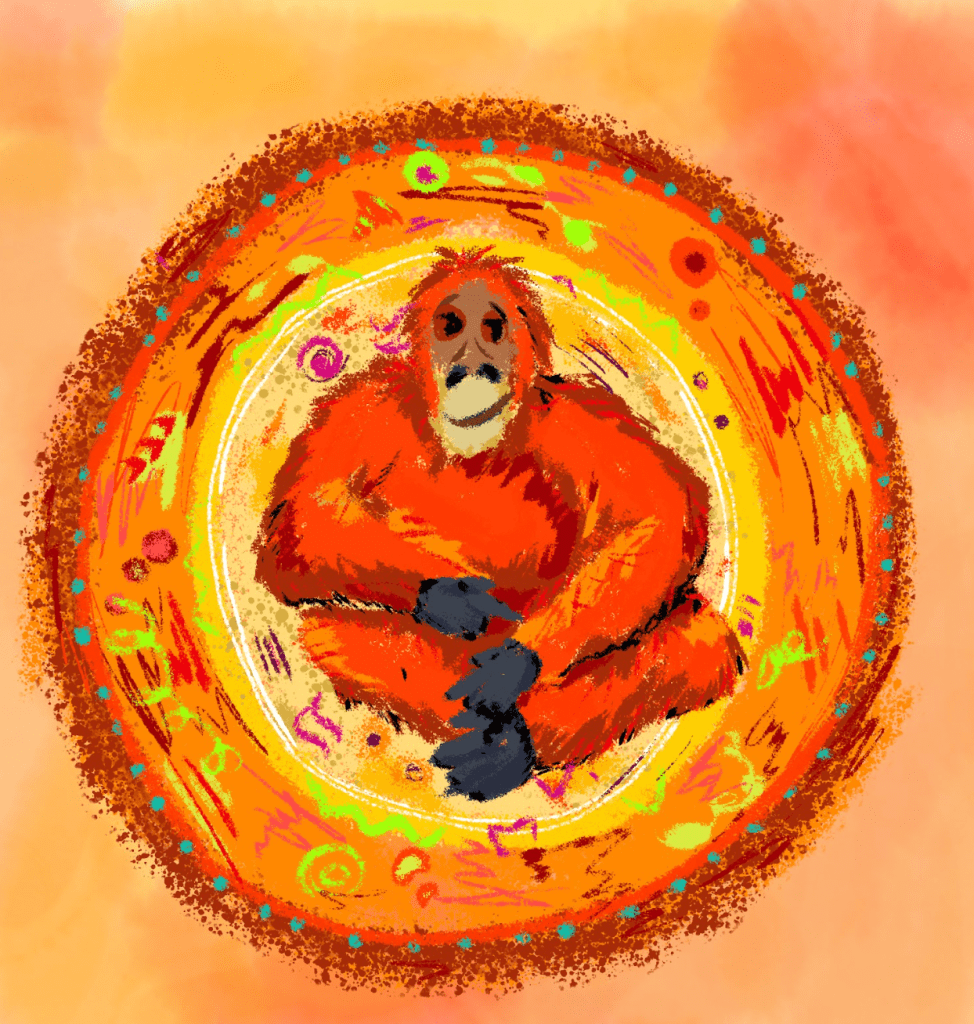
An orangutan, by the name of Amber, has captured the attention of millions over the past few months. An 18-year-old armed with an iPhone and a selection of household objects has created a viral series on TikTok under the username @pointingorangutan, where she visits Amber at the zoo and displays items to her through the glass enclosure. It feels like you’re watching a hairier version of your grandad, staring at the Greggs counter as he decides which corned beef pasty he wants, aloofly pointing out ‘that one’. With the dispassionate gaze of a veteran pointer, she gestures, as if to say ‘next’, at every object offered. Still, her curiosity is undeniable, and her TikTok audience is left with enough videos of her inspecting items to fill an afternoon.
Each new object revealed to Amber also sparks curiosity among the eager commenters who suggest what to bring next. In a sense, these TikToks and the responses from viewers echo the early days of scientific discovery. Before rigid methodologies were established, pioneers like Charles Darwin, Alexander von Humboldt, and other naturalists relied heavily on observation and a trial-and-error approach. In striking contrast to the rigidity, impenetrability and exclusivity of contemporary research, the public’s engagement and participation is encouraged; they watch closely and offer up suggestions of the next object to be introduced. The potential of interactions like these should not be dismissed, as we see a rise in citizen science projects, such as online camera trapping, playing a role in research.
Aside from entertainment value, these videos prompt fundamental questions about primate behaviour. By turning to research on primate cognition and communication, we can start to answer the questions viewers have been asking.
Is Amber an exceptional case? Amber’s behaviour, while remarkable, is not not an isolated case. Pointing and similar gestures are seen in orangutans and other great apes. However, it is certainly rare in the animal kingdom, as using gestures to communicate desires is typically understood to be a sign of complex thought. Complex thought involves forming abstract connections, anticipating outcomes, and intentionally communicating desires. When an animal points, expecting another to understand and act, it demonstrates more than a simple reaction—it shows an understanding of cause and effect and the ability to use symbolic communication.
Is she just imitating human behaviour? While Amber’s pointing could be seen as a result of her emulating human behaviours from frequent interactions, it is not purely a case of imitation. In the wild, orangutans and other great apes use gestures, including pointing, to communicate with each other. This suggests that while Amber may have refined her gesturing in response to human behaviour, the ability to use gestures like pointing is an innate aspect of orangutan communication.
Many of these gestures have “tight” meanings—that is, they are used consistently within specific contexts to convey particular intentions. One study found that orangutans in captivity could use up to 29 different gestures, each associated with a single, clear meaning, such as requesting food, initiating play, or signalling a desire to move together. This clear and purposeful use of gestures shows they strategically choose signals to achieve desired outcomes, reflecting their sophisticated cognitive and social skills.
What is Amber actually trying to communicate? Research suggests that orangutans will modify their signalling, if their needs are not met, using different gestures until their goals are achieved. Since Amber consistently uses the same gestures without variation, it is likely that she is successfully communicating her needs and getting what she wants from those interactions.
What does Amber understand about the person on the other side of the glass? Amber’s behaviour indicates an understanding that the person recording her is an independent being with intentions and actions that affect her environment. Studies on great ape cognition, including orangutans, indicate that these animals are capable of understanding that other beings have their own thoughts and intentions, a cognitive ability known as “theory of mind.” Her targeted pointing and adjustments based on the human’s responses imply that she recognises the recorder as another being with the capacity to understand and respond to her signals.
Does she recognise herself in the mirror? One of @pointingorangutans’s most captivating videos is when Amber is presented with a mirror. She stares at her reflection with such intensity that viewers are prompted to wonder if she recognises the image as herself. In the animal world, self-recognition is rare and considered an indicator of high cognitive abilities. Studies have shown that only a few animals, including certain primates, elephants, and dolphins, pass the “mirror test” of self-awareness. It is hard to say what is happening here, but the fact that she engages with her reflection suggests she may possess an understanding of her own identity.
Whilst Amber the orangutan may initially appear to be just another set of TikTok videos to provide you with a 100-second dopamine burst, they are undoubtedly sparking interesting discussions on how we think about animal curiosity and communication. TikTok users may unknowingly be prompted to ask deeper questions about animal intelligence, personality, and our relationship with them. These videos serve as accessible and engaging examples of primate cognition, capturing public imagination in a way that textbooks or research papers rarely do. Observing Amber stimulates discussion on topics like self-awareness, theory of mind, and the evolution of communication. While Amber may not know the extent of her viral fame, her subtle gestures and bemused expressions are inspiring people to think more deeply about what it means to share this planet with such extraordinary beings.
 Kinesis Magazine