
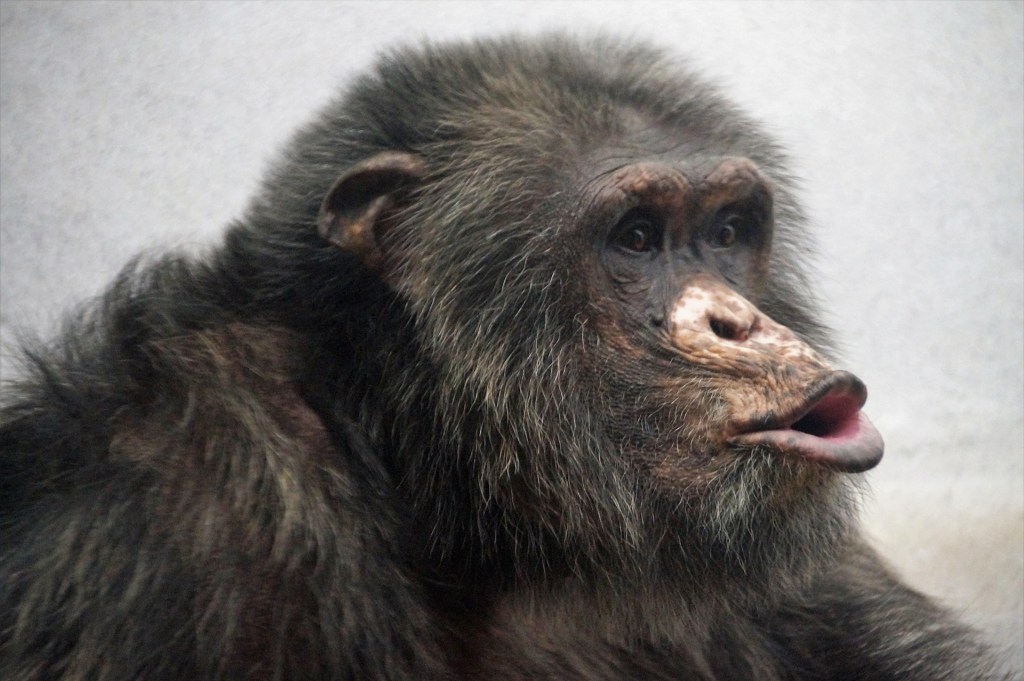
Photo by ivabalk on Pixabay
Writer: Kenny Xie
Editor: Altay Shaw
Words, words, words. We humans talk incessantly. Other animals may lack language, but their methods of communication are, for some species, quite obvious. Birds chirp, and dogs bark. Despite these, relatively little is known of how chimpanzees, our closest relatives, communicate. In light of this, a study of chimpanzee lip smacks by Pereira et al. (2020) shows that their communication may be closer to human speech than we originally realised.
Why lip smacks?
Grooming chimps often smack their lips. A previous study in 2015 by Fedurek et al. pointed out that in a population of 35 adult individuals, 65% smacked their lips when grooming. Interestingly, when chimps lip smacked in the first ten seconds of grooming, this activity not only occurred for longer periods of time but was also more likely to be reciprocated. Lip smacking also occurred more often when chimpanzees were grooming more vulnerable body parts, such as the head or genital area. As grooming in many primates is a social activity where individuals bond with each other, it makes sense to assume that mutual grooming, especially for longer times, reflects friendly relations between two individuals. Additionally, grooming sensitive body parts demands higher levels of intimacy, as no chimp will allow anyone it does not trust to handle these areas. In these cases, smacking lips may be a way to signal that one has no adverse intentions and therefore avoid a fight due to misunderstandings.
With these factors in mind, Fedurek’s study concluded that lip-smacking – both the sounds and associated facial expressions – is a way for chimpanzees to express friendliness and intimacy towards each other. The fact that it involves both sounds and facial expressions is similar to human speech: we also watch the facial movements of those speaking to us. This reflects similarities between chimpanzee and human communication: both are multimodal in that they combine different senses of both sight and sound. This feature gives these signals an advantage in that they can convey nuanced messages through combining vocalisations with facial expressions that would give more detail than either alone.
The Magic Frequency
If chimp lip smacking is a form of communication similar to human speech, it will likely include rapid cycles of opening and closing mouths that occur 2–7 times per second. This rhythm not only occurs in all human languages but also in primate signals such as gibbon calls and orangutan clicks. After analysing video footage of smacking lips in 14 chimpanzees in both wild and captive populations, Pereira’s team plotted the distance between the lower lip and the forehead against time for each clip. They then converted the data into a power spectrum of frequencies using Fourier transformations.
They found an average frequency of 4.15 cycles per second – right in the middle of the range for human speech rhythms. This presents us strong evidence that human speech shares origins with other forms of primate signals and could give us a potential evolutionary tree that starts with a common ancestral mode of vocalisation that eventually branched off into the many different calls, lip smacks and languages we hear today. It’s a massive clue in studying the conditions under which language evolved in humans and the long list of evolutionary steps that gave rise to this adaptation.
What the Smacks Could Tell Us
Monkey and gibbon calls are usually considered innate. In contrast, Pereira’s study found significant differences in lip smack rhythms both between individuals and across populations. Some individuals did not smack their lips at all or did so very sparingly. This difference gives us another clue in studying language evolution: Different rhythms suggest that lip-smacking is learnt socially, like human languages. Variations across populations resemble dialects in human languages and may be a way to distinguish between different chimpanzee groups. This is really significant, as chimp behaviour varies across populations so much that they, like humans (and bacteria), can be considered to form cultures. It’s also known that different populations fight and kill each other. Are rhythmic variations a way of establishing identities as a group, separating friend from foe?
In addition to this, the fact that each chimp has different lip-smacking rhythms also allows us to ask further questions. Can they recognise others by their rhythms—the way we recognise voices? If they can recognise others by their rhythms, it would indicate that chimps are capable of recognising and forming individual identities. A closer look at these lip-smacking chimps will give more context about both their sense of self and formation of group identity. Both of these can be used to inform scholars on human evolution, not only tracing the beginnings of language but also social structures that changed with it.
What next?
Back to the original question: what do chimps actually mean when they smack their lips? The truth is, we don’t really know. Currently there is no way for us to accurately decipher or interpret what exactly chimp lip smacks express. And even though these smacks are a form of communication, they clearly lack the level of meaning and syntax needed for a language. It’s up to scholars to investigate when and how our ancestors first created sounds that have meaning and strung them together in a certain way – building the first sentence.
Chimpanzees, as our closest relatives, are a flawed mirror for us to understand our origins. Their lip smacks share not only the rhythm of human languages but also fosters collaboration and group identity and engage multiple senses. It’s because of these similarities that these lip smacks provide helpful information regarding human language origins. Chimps, however, have different brain structures from humans and do not have larynxes that are able to produce wide ranges of sounds. This limits how effectively we can compare them to our ancestors – and leads to the bigger question of why we evolved in a different direction, with more powerful brains and vocal cords. Maybe someday in the future, we will answer all these questions and eventually understand what the chimp says.
 Kinesis Magazine