
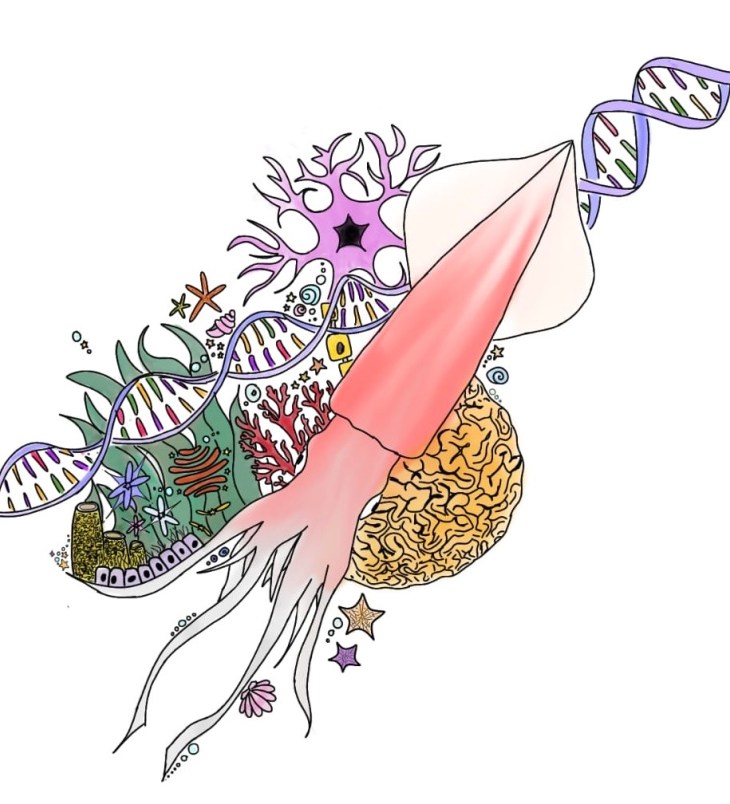
Writer: Maxime Chautemps
Editor: Sophie Rogers
Artist: Amy
Imagine this: you are a spiny dogfish – a slender, smooth and spined shark travelling in a pack of 100s. You swim through the dim light of the benthic depths, darting aggressively after whatever prey you spy that’s smaller than you. Then, you see them. A soft ethereal form at the edge of your vision, drifting gently, almost passively, through the murky water. You know that movement, that shape – sense their electric field – and so you thrust yourself towards them using the sideways undulation of your caudal fin. You extend your jaw and launch at it, only to shake your head in frustration milliseconds later as you get a mouthful of inky black mucus that scrambles your senses instead. In the distance you can just make out your missed meal already darting tens of metres away.
Jet propulsion is a mode of transport available to most cephalopods – the class of molluscs that includes octopuses, nautiluses, and cuttlefishes – but is perhaps most famous in the squids of the group. It serves a range of functions: from quick escapes, powerful predatory strikes, and even temporary “rocket propulsion” flight in several species.
Most of the time squids move by undulating their fins and gently expelling water out of their mantle, the muscular organ surrounding the core body like a hat. Water is taken in and expelled through a tubular extension of the mantle called the siphon that can orientate itself in multiple directions. When they need to generate a powerful but energy-taxing thrust, they can relax their mantle to draw in a larger amount of water then contract rapidly to force it out. This rapid movement is stimulated through an instantaneous electrical impulse that reaches all the muscles of the mantle simultaneously, only made possible thanks to specialised giant axons. These massive nerve fibers can be up to 1mm in diameter, 1000s of times wider than those in most vertebrates.
John Zacchary Young (1907-1997), a decade before he took up a post as Professor of Anatomy at UCL, redescribed these giant nerve fibres and brought them into the limelight of neurophysiology. Seemingly forgotten since Leonard Worcester Williams first described it in the longfin inshore squid (Loligo pealii) in 1909, Young rediscovered the giant squid axon completely by accident.
He had been working at the Stazione Zoologica in Naples where his collaborator Enrico Sereni introduced him to cephalopods as model organisms. Without an express end-goal, Young began investigating different structures in cephalopods, leading him to compare a strange ganglion structure he found in Eledone octopuses with L. pealii squids. Whilst he didn’t find the same structure, he did find something even stranger. A large ganglion in the mantle with star-like radiations of tubular structures big enough to see with the naked eye.
It wouldn’t be until 1938, after years of work split between the Plymouth Marine Laboratory and the Marine Biological Laboratory at Woods Hole, that Young would officially redescribe the stellate ganglion and prove its fibres to be massive motor neurons.
From the moment of its discovery, the squid giant axon revolutionised neuroscience. Its unique size allowed electrodes to be placed on both sides of the neuron, which teams at Plymouth and Woods Hole used in 1939 to measure the action potential across the axon for the first time. Alan Hodgkin and Andrew Huxley would later win a Nobel prize for their use of the giant squid axon to describe action potentials at the molecular level.
J. Z. Young went on to contribute to many areas of research in zoology and physiology. During WWII he worked with Peter Medawar at Oxford, where they once again used squids and octopuses as their models: this time to find treatment for wartime nerve injuries. Afterwards, he moved to UCL, where he worked for nearly three decades.
Reflecting on the impact cephalopods have had on neuroscience, J. Z. Young mused in a 1984 article that, “It is curious to think how different neuroscience would have been had I not made sections of a yellow spot out of simple curiosity.” He wondered then if, had he been an early-career scientist instead, whether the climate of science at the time would have allowed him to make such a discovery.
But forget 1984, what would Young think of the state of science and academia in 2026? How can that “simple curiosity” that research and innovation thrives off survive today when papers are trapped in the purgatory of a broken peer-review system, when wealth inequality prevents so many aspiring scientists from advancing, and when governments continue to gut funding?
We often characterise the investigative behaviour of octopuses as curiosity. Serious change is needed at UCL and throughout academia if scientific research is to continue being accessible, inclusive, and by extension curious. We shouldn’t be afraid to be more like an octopus, allowing students and researchers to stretch out their limbs towards wherever their curiosity is calling, sometimes in multiple directions at once.
 Kinesis Magazine