
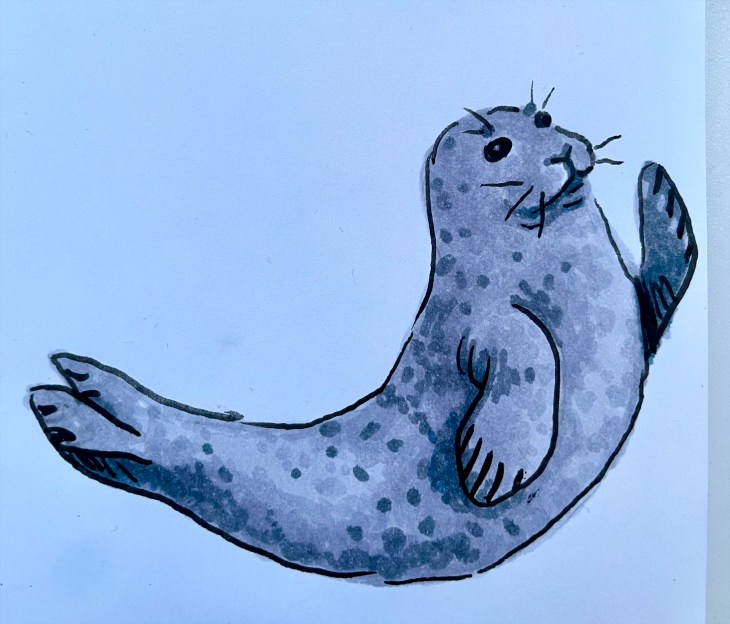
Writer: Lauren Grady (MRes Biodiversity, Evolution, and Conservation ‘26)
Artist: Annie Hollis-Barter
Along the Norfolk coastline and bordering the North Sea lies Blakeney Point, a seemingly unassuming field station nestled among sand dunes and grassy hills. A closer look into the point reveals a strikingly biodiverse ecosystem, a crucial piece of UCL history, and the starting point to coursework for biodiversity postgraduates.
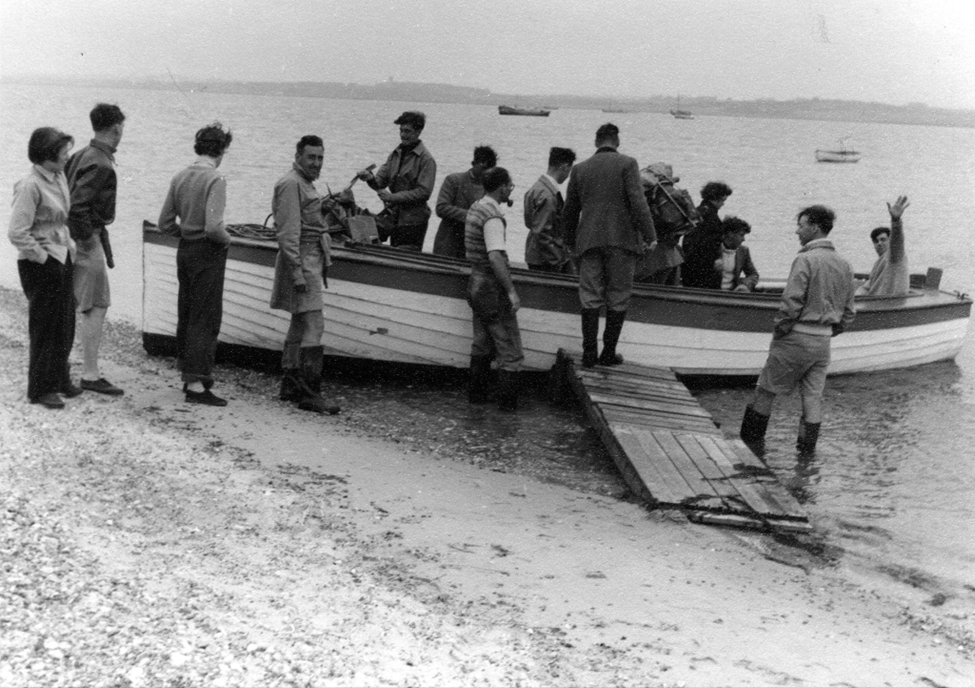
Students leaving Blakeney Point in June 1955 (Image provided by Tim Blackburn).
Blakeney Point has seen visits from UCL students for over a century. First established by Francis Wall Oliver, a professor of botany at UCL and field ecologist, the location of Blakeney Point was chosen due to its unique biodiversity and the dynamic nature of its geography. Today, a field trip to Blakeney Point serves as the start of two master’s courses: the MRes in Biodiversity, Evolution, and Conservation and the MSc in Biodiversity and Global Change.
“I’ve been going to Blakeney Point with UCL since about 2013 or 2014, but I’ve been going as a birdwatcher since the mid-1980s,” says Dr. Tim Blackburn, a professor of invasion biology and course lead for the MRes in Biodiversity, Evolution, and Conservation. “I just love the whole thing really.”
The start of the master’s courses through a field trip to Blakeney acts as an introduction to ecology and fieldwork, as well as the professors and course mates. While at the point, students are able to explore the local ecosystem through an exercise known as a ‘bio blitz,’ wake up early with the professors to open moth traps, and gain insight into field data collection and experimental design. This year, students were instructed to design a study to measure the prevalence of brown hares on the point. When asked why students are taken to the point at the beginning of each academic year, Blackburn emphasised the importance of experience. “It gives students a feel for what working in the field is like and exposes them to the systems we talk about [in lecture].”
Hands-on experience and the concept of a ‘living classroom’ are a crucial part of learning, especially in subjects like ecology. Living classrooms provide an immersive experience where students can apply the concepts and terminology they have learnt to the real world. These ideas are long-standing in environmental education. According to Kinslow et al. (2019), field-based environmental curriculums promote environmental literacy and socio-scientific reasoning in high school students, which aid critical thinking on modern environmental issues. Similar studies have been conducted on students in higher education, in which students not only benefitted academically from field-based learning opportunities but also preferred it to more traditional classroom learning. Blackburn echoed these sentiments when discussing the importance of Blakeney to environmental education at UCL: “Most of the course is theory, so getting people out sort of into the systems we’re talking about [and] thinking about the actual organisms in these systems is key.”
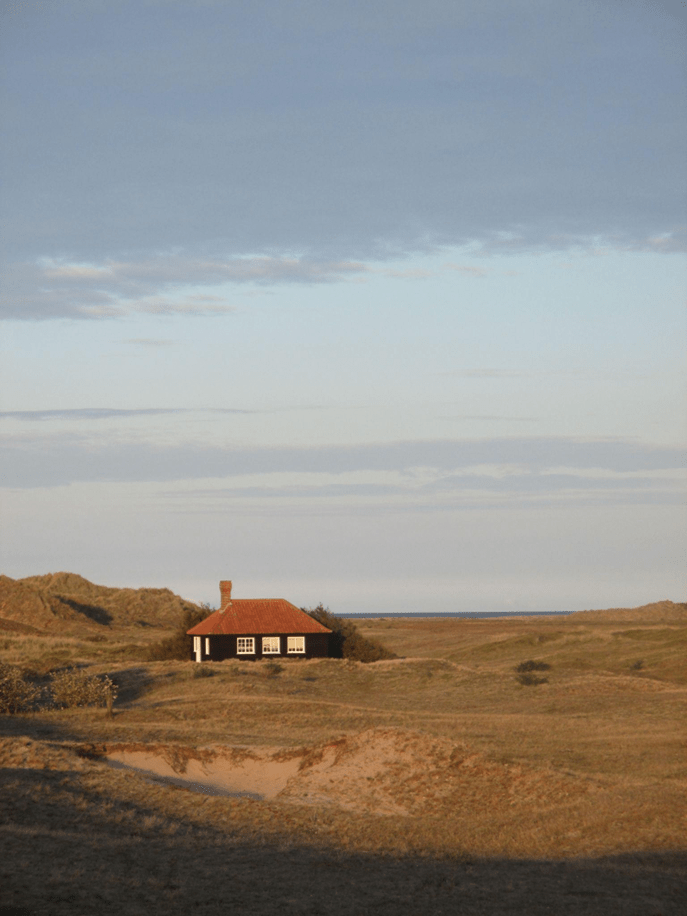
The Blakeney Point bunkhouse (Image credit: Lauren Grady).
Aside from hands-on learning, the Blakeney Point field trip also serves as a way for students and professors to connect with nature and each other. The single bunkhouse, split over two rooms and 10 bunks, is a cozy space where up to 15 students stay at a time, and a small dining hall with a singular table is the site where all meals are shared. “We really value the opportunity to get to know [the students],” says Blackburn. At downtime, students and professors find themselves conversing, reading, or exploring the nature preserve. The sense of community at Blakeney amongst students is palpable, and post-dinnertime allows for cards, games, and more bonding in the dining hall.
Though the time students share at Blakeney is brief, the experience is invaluable and remains a frequent topic of discussion in the taught coursework of biodiversity postgraduates. The introduction to experimental design prepares master’s students for their research projects later on in the course, and the exploration of Blakeney’s biodiversity aids students in discovering an appreciation for local wildlife. Blakeney Point has played a crucial role in environmental education at UCL for over 100 years and will continue to do so for generations of ecology students to come.
 Kinesis Magazine