
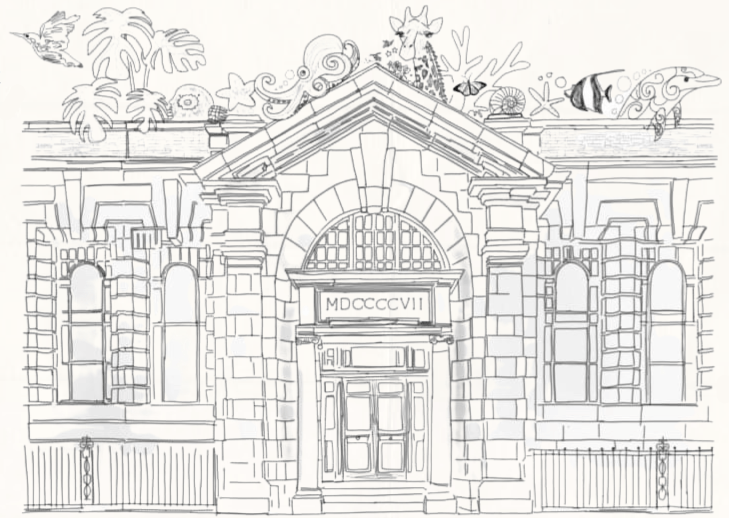
Writer: Justin Wang
Editor: Savina Hui
Artist: Amy Joseph
1826 was an important year for UCL, but for many others related to the newly founded university, 1826 was also life-changing. Such was the case for two figures, Dr. Robert Edmond Grant, and Mr. Charles Darwin.
That year, a young Darwin spent his time as a university student at the University of Edinburgh; just like many second-year undergraduates at UCL now, Darwin joined societies and even found an internship opportunity – collecting and documenting animal samples with a talented fellow, zoologist and marine biologist, Robert Edmond Grant.
A researcher with acute perception and the most developed methodologies, Dr Grant had brought back to Britain the most pioneering theories of evolution from Étienne Geoffroy Saint-Hilaire, disciple of French evolutionist Jean-Baptiste Lamarck. It was an unforgettable experience for Darwin to venture all the way with Dr. Grant across the Scottish coastlines, searching for small enclaves of life in shallow tidal pools.
While learning some lifelong effective research skills in the process, Darwin was also able to make his own discoveries in those fieldworks, an impressive feat for a young and inexperienced student like himself. Under Grant’s directions, Darwin was brought to the cutting edges of biology, learning how to systematically document his observations of the natural world. Grant made breakthroughs on the trip as well, surveying organisms like sponges, sea mats, and many other invertebrates. Much to the surprise of his peers, those marine lifeforms were animals rather than plants.
In late 1827, the two talented scholars parted ways as Darwin found studying medicine in Edinburgh unfitting for him. Meanwhile, Grant accepted a job offer from a newly founded higher education facility, University (College) of London, leaving the tidal pools for a settled, urban life. Darwin stepped on board the HMS Beagle three years later for its second voyage (the first voyage of the Beagle was in 1826, exactly the year UCL was founded!). The rest of Darwin’s legendary journey is now a well-known tale documented in The Origin of Species, a story not of Mister, but Sir Charles Darwin, the founding father of modern biology.
Whilst the ship of modern biology had set sail with Sir Charles Darwin to the world, in London, Dr. Grant was building a vault, a vault to hold all the wonders and the fruitful wonders of nature gathered worldwide. Dr. Grant would now be remembered as one of the first UCL faculty members. Grant was the only lecturer in UCL teaching comparative anatomy, a new discipline back then that is deeply connected to the now prosperous field of evolutionary biology.
Despite the sweeping changes in scientific paradigms, the life sciences explored similar themes over the years of development. In Grant’s time, comparative anatomy asked a series of questions framed very differently from traditional explorations of the mechanical details of tissues and organs. Traditionally, people ask vague and reductionist questions, such as “Why do elephants have long noses?”, but biologists ask a holistic and process-oriented question, like “What kind of complex mechanism contributed to the long noses of the elephants?” Comparative anatomy tackles similar problems of evolution with insights into animal morphology. By the 19th century, a majority of natural philosophers were cross-examining different species from a more holistic perspective. Instead of treating lifeforms as isolated cases, comparative, or “transcendental”, anatomy searched for trends among all living things. Such a new academic tradition is now cherished as the key spirit of the biological and life sciences.
Nevertheless, conducting studies of comparative anatomy required large quantities of well-documented specimen samples. In 1827, Grant started an initiative to tackle this problem. The newly arrived professor aimed to build a natural history museum similar to the one he likely visited in Edinburgh. This museum would later rapidly absorb animal samples and models over its nearly two-century history. Now known to us as the Grant Museum of Zoology and Comparative Anatomy, Grant’s vision coalesces into a systematic showcase of specimens that dazzles the public and UCL members alike. The museum has served its original purpose well; it facilitated biological research decades ago, and remains important to UCL as a key bank of historical and academic resources.
Cheers to Dr Grant! Unfortunately, a brilliant idea lingering to this day did not bring Grant any fame and prestige while he was in London. The competitive nature of academia severely hindered Robert Edmond Grant’s career in London. He was outcompeted by his political and academic rival, while a shortage of students attending his outdated lectures worsened his financial conditions. Due to Grant’s habit of burning personal works, we have only a vague portrait of his late personal life. In Charles Darwin’s autobiography, he described a younger Grant in Scotland as a passionate and talented scholar, well ahead of his time, but that passion ended up in a stubborn character, refusing to move on when his past trainee, Darwin, sparked a revolution in the life sciences.
Over the years, the Grant Museum has changed locations multiple times, but it has always been used for studies of animal morphology, taxonomy, and embryology. The value of its specimens persisted as biological research entered a new era: Watson and Crick’s discovery of DNA and the creation of molecular biology and phylogenetics. Nowadays, the Grant Museum has become not only a treasury of animal species, but also a genome bank, and a place of historical memories, with some parts of its collection dating back to Grant himself.
The modern study of all living beings has set sail with the Beagle since 1831, with the Grant Museum since 1827, and with UCL, for a total of 200 years dedicated to scientific endeavours.
 Kinesis Magazine