
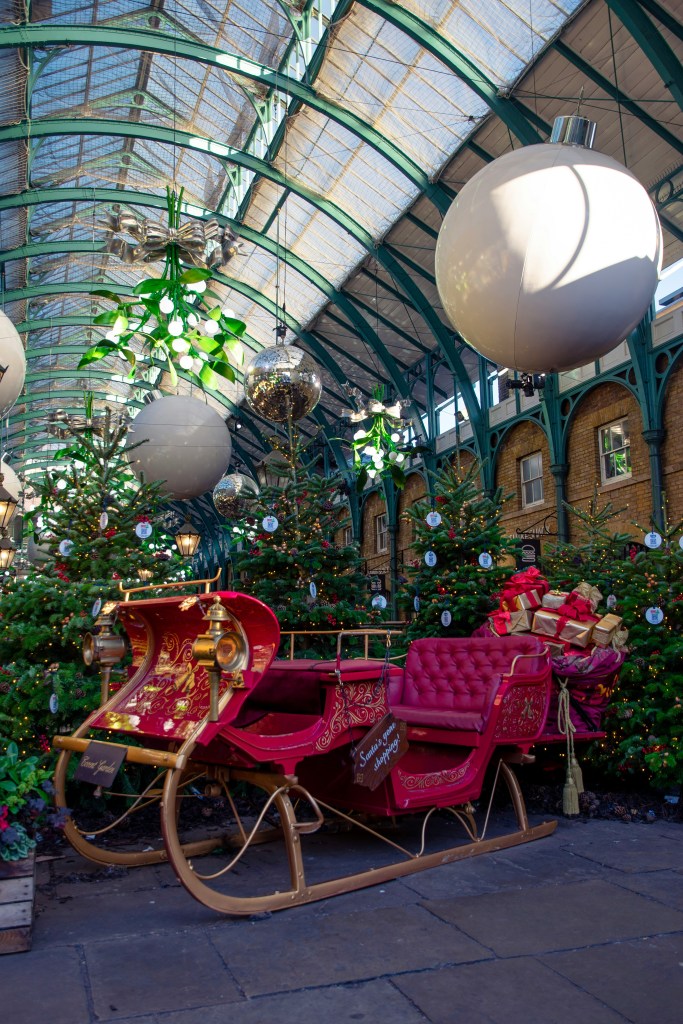
Picture: Picture of Santa’s Sleigh in Covent Garden, London, UK. Published on December 16, 2022, https://unsplash.com/photos/a-bunch-of-christmas-trees-that-are-in-a-building-3kxTbo8PpbA, taken by George Ciobra
Author: Altay Shaw
By yesterday evening, millions of people around the world had opened their gifts for Christmas. Though estimates can vary, projections can suggest that more than 700 million children received presents for Christmas, though this number does go off of calculations that were done in 2018. Or, to put it another way, over 310 million homes would have been visited by Jolly Saint Nick if we use more up-to-date estimates.
But how fast would Santa have had to go to deliver all of those presents? And what would the sleigh have to look like to do so?
First, we need to consider the distance covered. In the cities where most of our readers reside, they typically envision an average journey consisting of numerous properties in close proximity, either arranged in blocks or as terraced or even detached houses one after the other. However, in certain areas of the world, houses are spaced apart. Suggestions from researchers at the University of Leicester would place that distance at about 160 million kilometres.
Secondly, we would need to consider the time period Santa has to deliver presents. In London, the sunset was at 15:55 on the 24th of December. Sunrise occurred at 08:05 on Christmas Day, giving approximately 16 hours and 10 minutes of night running for Santa for the GMT-observing areas of the world. Santa also had to cover other parts of the world, meaning we need to account for time zones. Overall, Santa gains another 18 or so hours, making a total of 34 hours to cover all the stops he needed to make.
These figures would mean Santa visited more than 1900 households per second during his busiest night of the year. And you thought getting up to go to your 9am lecture was bad.
Doing the math would suggest that Santa would have gone 4.7 million kilometres per hour, or 6.8 times faster than the NASA Parker Solar Probe.
Now, needless to say, unless you want to visualise Santa as one of the subatomic particles fired at the CERN supercollider, it is doubtful we would be able to design and make something like Santa’s sleigh work. But, maybe, that is the power of some Christmas magic.
 Kinesis Magazine