
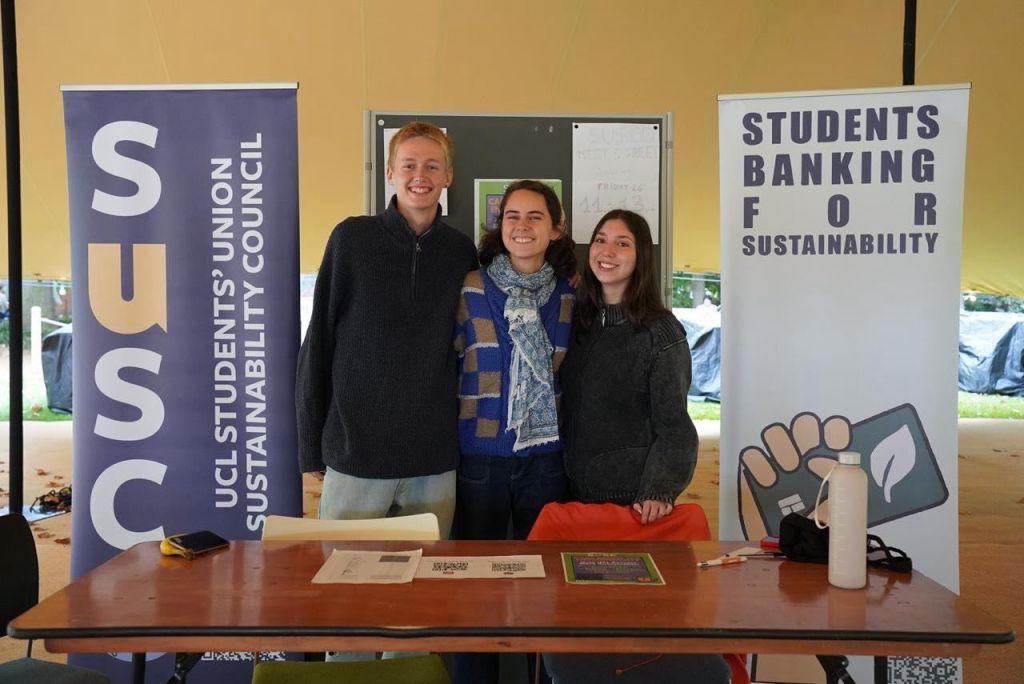
Pictured are (left to right): Oskar Barltrop Pauline Le Gal (Sustainability Officers) and Clara Cohn (Sustainability Council Education Lead)
Author: Altay Shaw
Following a difficult past year with delays in the zones, the sustainability officers for this year are ready to make a change. We sat down with Oskar Barltrop to ask him about his plans for the year ahead and the importance of activism on campus.
Speaking with Kinesis Magazine following the sustainability conference, Sustainability Officer Oskar Barltrop, who is in a job share with Pauline Le Gal, expressed his frustrations with the SU, saying that working with the Student Union can be “challenging”, referring to the process as a “game of chess … against UK laws and the SU’s systems and structures.”
Within his role, Oskar works with Pauline to lead efforts across campus, including within the Sustainability Council’s Banking Task Force, where students are empowered and upskilled to educate other students about their choice of bank and its effect on fuelling and funding the climate crisis, and the Education Task Force, which aims to work with Fossil Free Careers, in the hope that universities will guide students to sustainable careers and stop platforming and advertising oil, gas or mining industries.
The sustainability officer described the process as a “game of trying to find which SU staff have the flexibility to move in a new direction” when trying to introduce new policies to campus. He said that he wants to work with staff “so that we can move in a more positive direction together.” He added, “Most staff are very supportive at the individual level but are often too hesitant to push for change and instead play it safe with the status quo.”
Oskar also provided a comment with regard to noticeably larger topics that continue to catch the attention of students at UCL. Israel’s genocide in Palestine has been met with staff being slower to respond; as Oskar puts it, “[staff] are very wary of pushing too much, and so I feel that I face a lot of pushback in that area.”
He gave the example of his and Pauline’s Officer webpage being an example, stating, “It used to say, ‘Advocating an intersectional approach to climate action, e.g., connecting the dots between the genocide against Palestinians and the oil industry or LGBTQ+ rights and climate change.'” And now it says, “Advocating an intersectional approach to climate action, e.g., connecting the dots between the global oil industry and genocidal acts or LGBTQ+ rights and climate change.”
Another example he names is during his ‘A Student’s Guide to UCL’ talks which he gave to first years during Welcome Week, where he was prevented from going on stage in the Bloomsbury Theatre when wearing a pro-Palestine jersey and was forced to put a jumper on top. He was later allowed to go on stage wearing a keffiyeh.
The desire to see the Students’ Union move faster with its decision-making process is nothing new. Last year, work on Fossil Free Careers faced multiple delays, as both societies and sabbatical officers stalled the progress of the motion through the zones. And even when the SU does pass policy, breaches occur, most recently during the Welcome Fair, where the Union marketed deals with banks and aviation companies.
Alan Salazar, the previous sustainability officer, initially proposed Fossil Free Careers, but it faced numerous delays. He sent multiple follow-up emails over several months without any response from anyone, including sabbatical officers, within the SU. Oskar states that it could be the “5th, 7th, 9th… follow-up email without getting a reply”. Despite the unresponsiveness of the education officer last year, the Union failed to provide alternative staff members for students to meet with and voice their concerns, particularly when the education officer was absent.
Oskar also highlights the difficulties of trying to get simpler, union-controlled changes passed. Referencing the ever-growing cost of living, the SU initially promised to deliver at least one hot meal, which cost less than £3, but then later claimed that the policy didn’t apply to them – instead claiming it only applied to UCL. “Last year this was Print Room Cafe’s ‘jacket potato with cheese and beans’ for £2.50; this year that meal costs £3.50 or £3 if you only have one of cheese/beans.” With the number of students accessing food banks more than doubling since 2022, the need for affordability on campus has never been greater. Yet, the implementation of decisions and the pursuit of meaningful changes on campus face significant obstacles. Many sabbatical officers were elected promising to bring down the price of food items in its outlets, yet so far the prices have only gone up.
To ensure progress is continued on campus, Oskar suggested that “one easy way for the SU to give more power to students (who will then take a stronger stance on Palestine and move the SU in a progressive direction more quickly) is to put more resources into supporting its student leaders and into implementing the motions which students have passed.”
“Sabbatical Officers have a much larger say on which organisations the SU should work with, and they are more regularly given access to the rooms where these decisions are made. If I were a sabbatical officer, then I would be able to do a lot more, a lot faster than I currently can.” “It will be fascinating to see what direction the SU takes on Palestine, sustainability and the cost of living crisis over the next year.” Oskar indicated that, while he recognises that SU is trying to work on all of these areas, there is a need for progress to be made sooner rather than later.
If you wish to learn more about Oskar’s work as Sustainability Officer, you can view the current policies he and Pauline are working on here. Alternatively, if you have any questions or wish to support the work that is going on or have a question, you can email them at su.sustainability-officer@ucl.ac.uk.
 Kinesis Magazine