
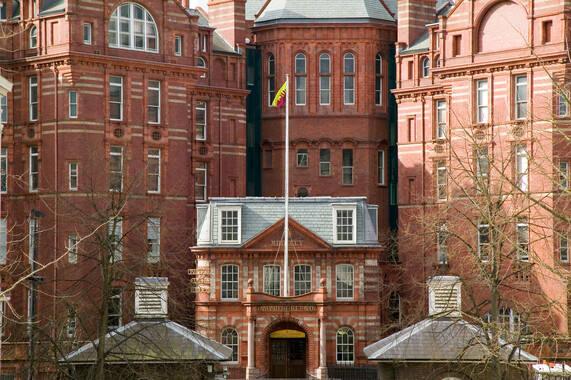
Picture of the Cruciform Building, Photograph by Media Services Photographic Archive/UCL Imagestore
Author: Altay Shaw
Editor: Sophie Rogers
In just over a week’s time, University College London will be electing students to serve as their representatives within the Student Union. These individuals will hold about 600 times the voting power of the average student on campus and will be able to influence policy across several different areas. If these individuals vote for a specific policy, that can be brought to the Union Executive and become the focus of the Student Union and the Sabbatical Officers as a whole.
Every individual at UCL should continue to be concerned about the fact that only 2712 people cast ballots in the Rep Elections last year, given the importance of these roles. That comes out to just 5% of UCL’s total student population voting for the individuals who get the final say as to whether policy ideas can progress any further.
For medical students like myself, this drives forward an even larger concern. I am now in the clinical years of my programme, and I go on placements to help patients in any way that I can. Sometimes this involves documentation, sometimes reviewing results and even acting as a translator and advocate for patients. Only 33 individuals voted for the sole representation for undergraduate clinical year students in the Education Zone. Considering that at least 1000 students are eligible to vote in this race highlights just how dire the situation is.
However, this is only the beginning for medical students at UCL. Let’s take the race for societies’ welfare reps last year. Last year, only two students ran for positions that could accommodate up to four representatives responsible for addressing the needs of welfare officers and promoting the wellbeing of over 300 societies. And even then, the candidates remain focused on the same core topics as individuals have said for years. Though there was no formal election for the Welfare Reps at the same time in 2023, the needs of our students do not change year on year. Therefore, addressing these topics doesn’t result in significant advancements for the students who directly experience them.
“The same is said every year (better communication, reaching out, etc.), and I appreciate it. But if the same messages are being said, this may be due to a deeper, centralised issue that is not being changed,” says Welfare Vice President of RUMS, Iman Monir. The Welfare VP won her election in a dominant fashion during the Leadership Race, and her work throughout the past year with the previous Welfare VP, Dylan Kotecha, showed she was invested in leading change for students.
Asked about what she thought were the challenges to getting better representation for medics within the Rep Elections, she said, “This means people aren’t applying or don’t know about it. And I think it’s more the latter; I didn’t know about this. And if people don’t know, you can’t represent UCL as a whole, including UCLMS, making it somewhat defunct.”
Following in her predecessors’ steps, Iman has put together her team of Welfare Representatives for medical students across all years, trying to continue building off of what was done last year for the clinical students by trying to have at least 1 rep between the main sites. Though progress is slow, on account of SU bureaucracy and issues with funding when it comes to welfare week, she believes that there is a chance for progress to be made.
When asked about the low application rates for student representatives, Iman commented, “I think it’s less of a student issue and more of a UCL-wide issue, focussing on communication and prioritising wellbeing.”
Despite this lack of engagement from the reps who have put themselves forward this year, Iman is not content to let medical students be forgotten in all of this. She is creating focus groups and collecting hard evidence to drive changes within the medical school; reaching out to the surrounding hospitals students are placed at and seeking funds to support welfare initiatives.
While the Student Union does advertise these roles for students, it fails to truly highlight their significance on the introductory page to the Representative Elections. The webpage for the Representative Elections does not mention the progress or examples of what their predecessors did, nor does it indicate how much change representatives can enact.
If we continue to struggle to highlight the importance of these roles, we will continue to undervalue them and treat them as minor. This will undermine the significance of their contributions and the role of student democracy in transforming the wellbeing landscape at UCL.
If you are a student who is running to be a Welfare Representative for the Student Elections, we would love to hear from you. Please contact us directly via our social media platforms or through our email , su-kinesismagazinesociety@ucl.ac.uk
 Kinesis Magazine