
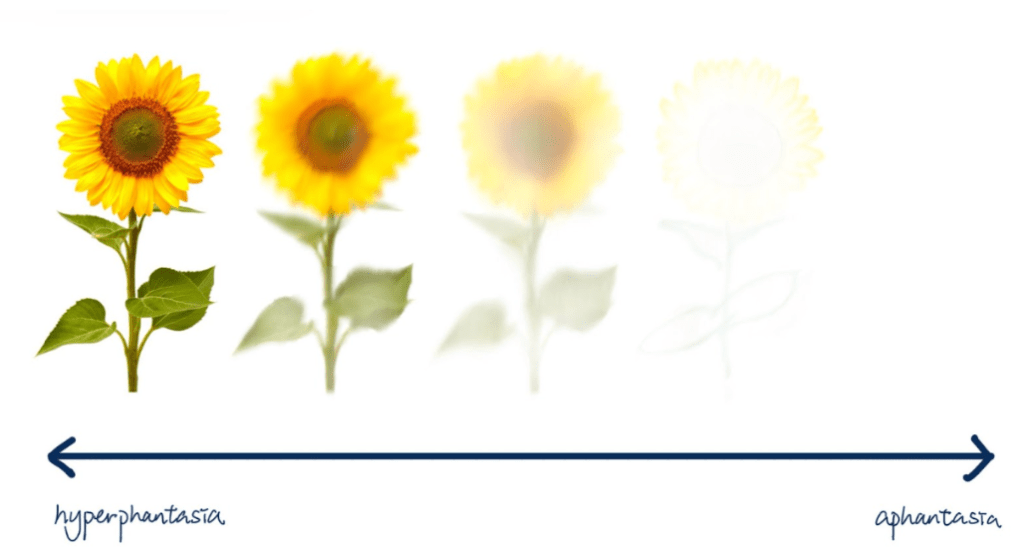
An image illustrating the spectrum of vividness of visual imagery. “Hyperphantasia” refers to hyperrealistic visual imagery, while “aphantasia” refers to the complete lack of visual imagery.
Author: Lorrine Sum
Editor: Altay Shaw
Close your eyes and picture a sunflower. What do you see?
While most people might conjure a slightly blurred and faded image of the flower, for others, the picture will be just as vivid as real life, containing minute details such as the veins on the flower’s bright yellow petals and the densely packed florets in its centre. Conversely, some individuals will see nothing at all, instead having related concepts such as petals, leaves and the sun flash across their minds. These people, comprising around 4% of the general population, have a condition known as aphantasia. The term was coined by Dr. Adam Zeman in 2015, after a patient reported that he could no longer visualise images after surgery. Despite its seemingly recent discovery, the phenomenon was recognised as early as 1880 when Francis Galton conducted the Breakfast Study, asking participants to imagine their breakfast table and describe the resultant mental image.
Currently, the main diagnostic tool for aphantasia is the Vividness of Visual Imagery Questionnaire (VVIQ), where participants are asked to rate the vividness of their visual imagery in different scenarios on a scale of 1 to 5. However, since the test results rely entirely on the participant’s subjective self-perception, doubts have been raised regarding the existence of aphantasia. Are aphants (individuals with aphantasia) truly devoid of visual imagery, or do they simply perceive and describe it differently?
Scientists have thus set out to develop objective, physiological methods of measuring visual imagery. One such method, developed by a team from the University of New South Wales in 2022, takes advantage of the pupillary light response to quantify the vividness of mental images. Our pupils constrict when exposed to bright shapes and dilate when exposed to dark shapes. When researchers instructed non-aphantasic participants (those who self-reported as capable of visual imagery) to visualise bright and dark shapes, they found that their pupils constricted and dilated as if they were seeing the shapes. Those reporting more vivid visual imagery also had a stronger pupillary response. On the other hand, aphantasic participants (those who self-reported as incapable of visual imagery) showed no pupillary response when tasked with imagining bright and dark shapes.
The research team also asked aphantasic participants to simultaneously visualise four shapes, a task demanding greater mental effort than visualising a single shape. This time, they found that the participant’s pupils dilated regardless of the brightness of the shapes. As our pupils dilate with increased mental effort, this suggests that aphants do engage in imagination, albeit in a non-visual way.
While the scientific community has yet to reach a consensus regarding the neural basis of aphantasia, some theories have emerged from functional Magnetic Resonance Imaging (fMRI) studies. One study has found that those with hyperphantasia show stronger connectivity between the prefrontal cortices and the visual network compared to those with aphantasia, while another study further suggests a disconnection between the fusiform imagery node, a region in the left fusiform gyrus, and the frontoparietal regions in aphants. In a case study involving a patient who developed aphantasia following a stroke, researchers also identified a selective lesion in the left fusiform gyrus, suggesting that the region plays a key role in the creation of visual imagery.
Although the term “aphantasia” literally means a lack of imagination, this does not imply that aphants are at all lacking in the creative department. A famous example is the best-selling author John Green, who expressed incredulity on social media regarding others’ ability to visualise mentally. Aphants can even excel as visual artists. In this article from the Aphantasia Network, an aphantasic visual artist shares her story and creative process.
While a complete lack of visual imagery can be difficult to comprehend, the recent surge in attention towards aphantasia offers a precious opportunity to glimpse the inner workings of a mind different to our own. Scientific research on aphantasia will not only further our understanding of the neural mechanisms underpinning imagination, but also enable us to explore the relationship between visual imagery and our daily experiences, pointing towards promising avenues for further investigation.
 Kinesis Magazine