
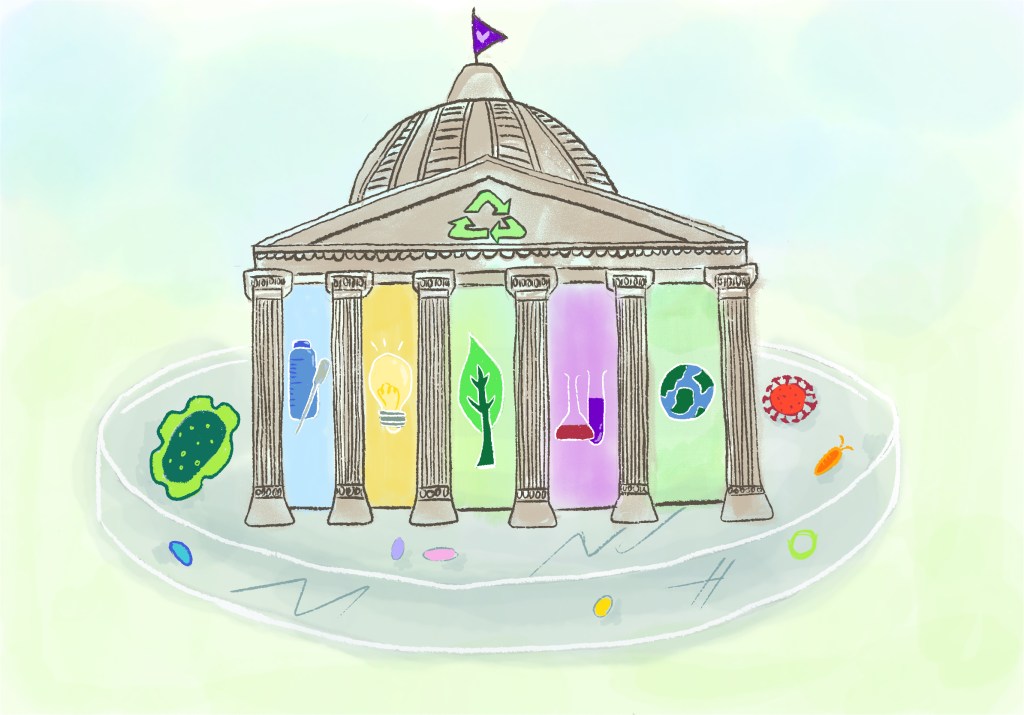
Author: Rachel Grosberg
Artist: Naomi Chung
Editor: Katie Kavanagh
The impending climate disaster is finally causing a paradigm shift towards sustainability across all sectors and regions. As the research sector continues to grow more rapidly than ever before, us budding scientists at a world leading research institution have the opportunity to shape the values of our future careers, and the responsibility to ensure laboratories do not fall behind in sustainability.
Scientific research, whether it’s life or physical sciences, has a massive environmental impact. Most laboratories consume 5-10 times more energy and about 5 times more water per square foot than commercial office buildings. Moreover, the gross amounts of waste generated by labs either ends up polluting landfills or being incinerated and contributing to air pollution. To put the scale of the issue into perspective, laboratories’ single-use plastic waste (from pipette tips to falcon tubes to petri dishes, and many more) accounts for at least 2% of global plastic waste annually. The most recent IPCC synthesis report (Intergovernmental Panel on Climate Change) strongly advocates that immediate action in alignment with net zero CO2 emissions across all sectors is necessary to limit human-caused global warming by 2oC and save the world from the irreversible chain of events leading to environmental collapse. Given the extent of the laboratories’ impact, and the critical point global warming is rapidly heading toward, it is vital that we question how we can reduce laboratory waste and consumption.
Today single-use plastics are regarded as gold-standard in research, as sterility is guaranteed and most plastics are unreactive,meaning scientists can be assured their results won’t be tainted by their methodology. The truth is that modern scientific laboratories existed long before the normalized overconsumption of single-use plastics (I’m sure most PIs can recount using glass petri dishes and pipettes during their PhD days), not all experiments require perfect sterility, and there are alternative unreactive materials that could replace plastics and reduce waste. Therefore, making labs more sustainable may not mean completely re-inventing the wheel or compromising research quality, but reconsidering best practices and perhaps reinstating some older, forgotten, common practices.
Ideally, this would be considered across all UCL labs, which is what Martin Farley envisioned when he founded Laboratory Efficiency Assessment Framework (LEAF), a lab-focused sustainability guide to help improve efficiency and sustainability in the lab. Laboratories are awarded either bronze, silver or gold level, depending on how many sustainable actions they have performed from the provided workbook. These types of initiatives are incredibly valuable, but the LEAF action points are relatively rudimentary, and participation is not guaranteed across all UCL labs – areas UCL can definitely improve on.Some labs at UCL have recognized this and gone one step further by having monthly sustainability meetings to audit their own progress and brainstorm new ways to make their research more sustainable, beyond LEAF’s suggestions. The UCL Zebrafish labs have been making huge strides in this regard. Their own internal audits revealing that they throw away 130 kg of plastic petri dishes each year, lead them to start a wash and reuse scheme to try to reduce this waste. Aside from plastic reduction, they worked out that they can reduce the energy consumption of their ultra-low freezers by 30-40% simply by increasing the temperature from -70 to -80oC. In a blog post they shared all the changes they’ve been able to make, supported by their own empirical evidence that it doesn’t affect experimental results. Zebrafish labs across the world have since reached out saying they’ve adopted some of the practices into their own research – a win for sustainable open science!
 Kinesis Magazine