
Author: Hyunseo Noh
Artist: Naomi Chung
Editor: Katie Kavanagh
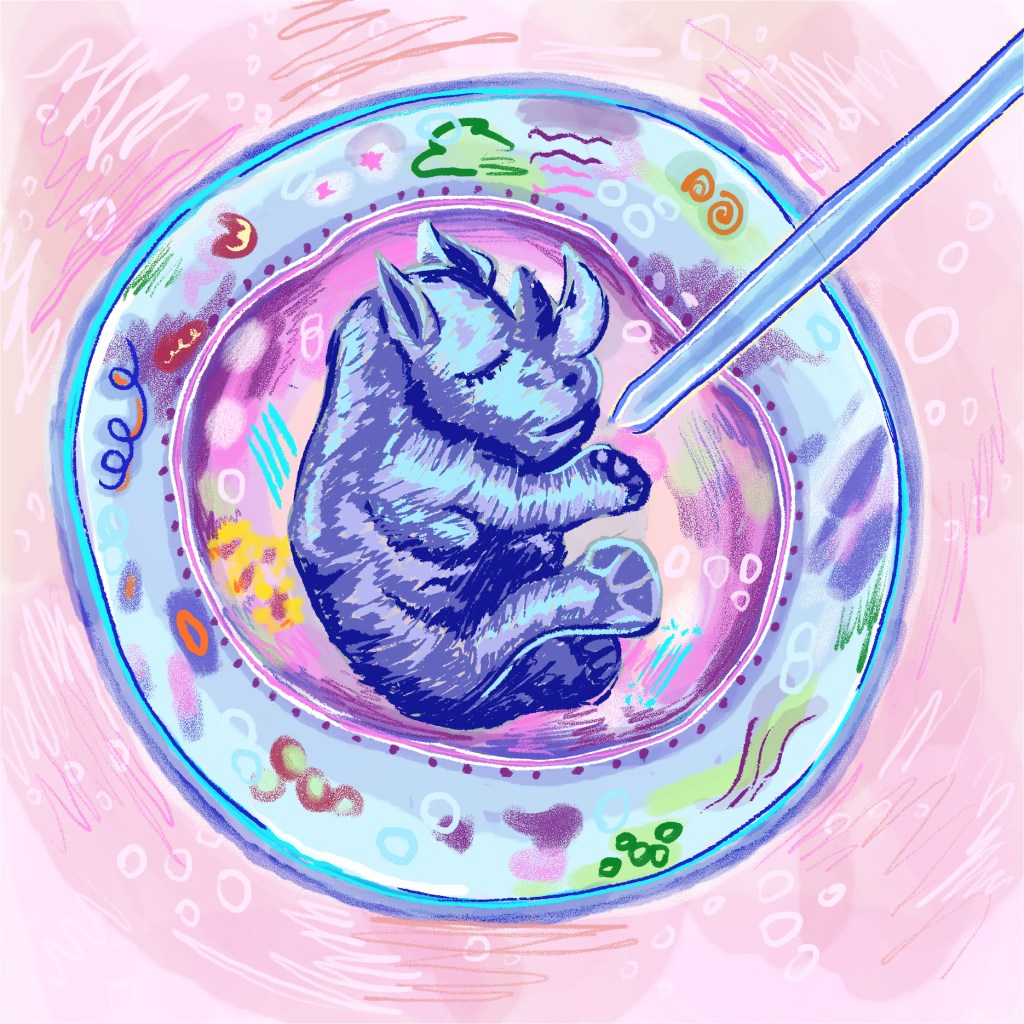
In the field of conservation biology, there are few success stories as captivating as the recent achievement in the field of assisted reproductive technology (ART). The remarkable tale of the world’s first rhino IVF not only signifies a significant breakthrough in wildlife preservation but also highlights the convergence of scientific disciplines in the quest to safeguard endangered species. This groundbreaking endeavour originated from the critical state of the white rhino, which faces imminent extinction due to prolonged poaching and habitat destruction. However, amidst the bleak outlook, a glimmer of hope emerged when scientists decided to utilise in vitro fertilisation (IVF) techniques to rescue the subspecies from extinction.
The BioRescue project, a global initiative led by scientists and conservationists, successfully transferred a southern white rhino embryo into a surrogate mother at Kenya’s Ol Pejeta Conservancy on September 24, 2023. Despite the surrogate mother’s unfortunate death during pregnancy, this milestone validated the efficacy of the embryo transfer technique, providing hope for the future use of northern white rhino embryos. Led by the Leibniz Institute for Zoo and Wildlife Research (Leibniz-IZW), the BioRescue team employed cutting-edge reproductive technologies to produce embryos from harvested egg cells and sperm, signalling a pivotal moment in the quest to rescue the northern white rhino from extinction. The project’s success is underscored by its innovative approach, as the transfer of rhino embryos had never been attempted before and required the development of novel protocols and equipment tailored specifically for these endangered animals. The BioRescue project’s ultimate goal is to prevent the extinction of the northern white rhino, a subspecies represented by only two surviving individuals, Najin and Fatu. To achieve this goal, the project has cryopreserved genetic material from 12 other northern white rhinos, as well as produced and preserved 30 embryos for future use. These embryos, stored in liquid nitrogen at facilities in Berlin, Germany, and Cremona, Italy, represent a crucial resource for the conservation of the species.
UCL stands at the forefront of ART with their research conducted on fertility and IVF. Through initiatives such as the P3 Study, UCL has explored the complexities of fertility following IVF, presenting the first systematic review and meta-analysis of data concerning the occurrence of pregnancy by natural conception following ART live births. Moreover, studies conducted by UCL’s Great Ormond Street Institute of Child Health have explored the long-term health outcomes of ART-born children, providing invaluable insights into the safety and efficacy of these reproductive technologies. Furthermore, UCL’s Department of Genetics, Environment, and Evolution (GEE) conducts groundbreaking research in biodiversity conservation, leveraging genetic technologies to safeguard endangered species and preserve biodiversity. With the use of genomic analysis, UCL scientists are unravelling the mystery of species diversity and evolutionary processes, offering innovative solutions to mitigate the biodiversity crisis.
In essence, the world’s first rhino IVF serves as an important reminder of the profound interconnectedness of science and conservation. As we stand at the crossroads of technological innovation and ecological responsibility, the convergence of ART and biodiversity conservation offers a beacon of hope. By harnessing the collective expertise of interdisciplinary research teams, we can move towards a more sustainable and biodiverse world.
 Kinesis Magazine