
Author: Amber Stratton
Artist: Macarena Undurraga
Editor: Miranda Hitchens
In early September, I found myself looking into a glass cabinet at Croatia’s modest Natural History Museum in Split. I noticed these Frankenstein-like structures of shells adorned with bits of coral, rocks, smaller shells, and sometimes even shark teeth or sea glass, as if they had been superglued together. But instead of being the work of an eccentric museum curator, they were built by the creatures themselves.
These specimens were shells from the Xenophora; a genus of snails that collage themselves by adding things to their own shells. Objects are chosen and positioned using their proboscis, a long, extendable tube with a harpoon-like tooth at the tip. Then, a special glue made of calcium carbonate is secreted from their mantle, the organ that forms the outer wall of the snail’s body and builds up their shell. This crystallises and hardens, permanently sticking the object to its shell. Each snail is unique, forming beautiful, complex structures; sometimes they assemble uniform radiating patterns on their shells, whilst others appear more irregular and chaotic. The protrusions function as armour, defending and camouflaging them from predators. For snails inhabiting deeper waters, their increased surface area helps prevent them from sinking into the soft floor.
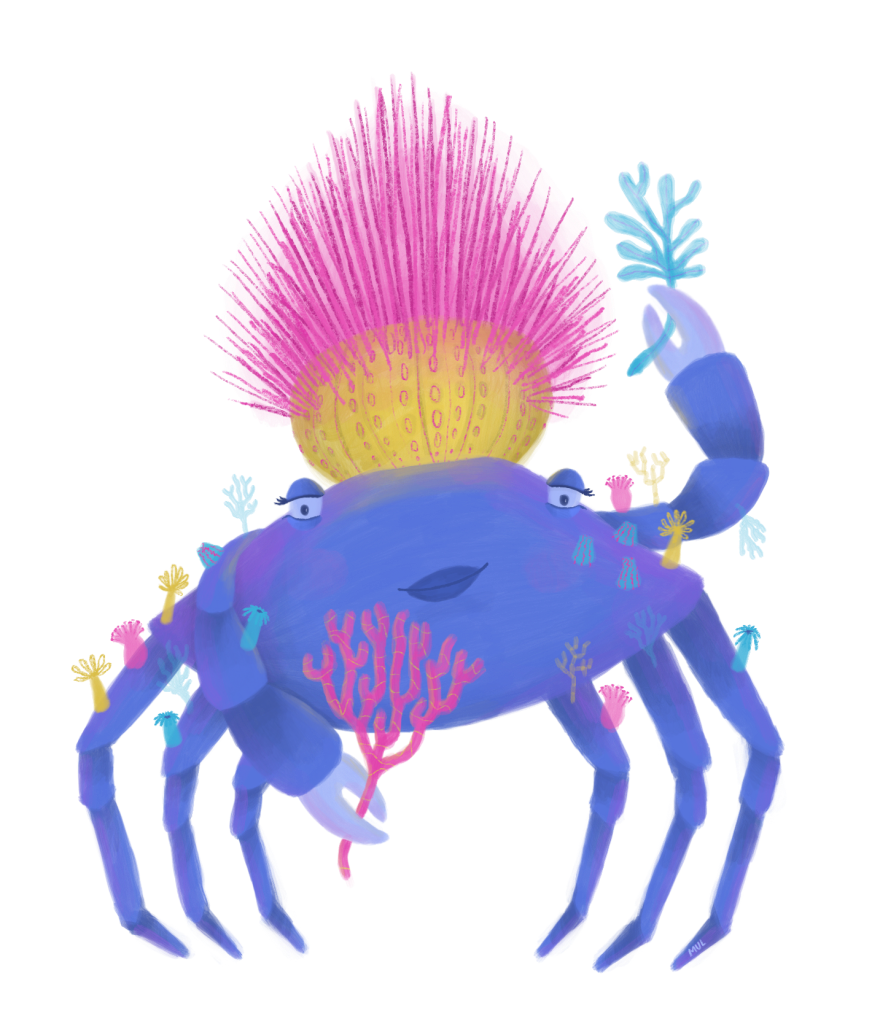
Despite their beauty, Xenophora clearly aren’t acting out of a profound appreciation for the visual arts; this behaviour is practical, providing evolutionary advantages to them. I began to question whether animals exist that do have an appreciation for aesthetics. As I delved deeper I found numerous examples of animals decorating themselves, from caddisfly larvae forming ornate cases to pupate in, to decorator crabs camouflaging themselves with different objects. But it was the ones that appeared to have no increased fitness associated with such behaviours that struck me the most.
Male bowerbirds build structures called bowers, made of thatched sticks and decorated with colourful objects, as part of their mating ritual. Females choose a mate based on the appearance of his bower. Each bower is unique; a study from 1985 showed that when provided poker chips of different colours as decorations, there were distinct preferences for certain colours between individuals. Furthermore, the birds positioned the poker chips in a very intentional way, grouping colours together, and sometimes even changing their minds and reorganising. The researcher John Endler puts forward that bowerbirds have an aesthetic sense and create art, as the structures serve no clear purpose, and this sense is required for building and judging them.
Many animals exhibit behaviours which could be interpreted as ‘fashion trends’; in 1987, there were sightings of orcas wearing dead salmon on their heads. One female was observed starting this trend, which was then copied by others in her pod during a 5-6 week period. After this, there were no more sightings of orcas with salmon hats. Again, this behaviour seemed to have no practical benefits.
Similarly, in a Zambian chimpanzee orphanage in 2010, a chimpanzee named Julie was seen picking blades of glass and sticking them in her ear. Over the course of a year, other members of the group copied this behaviour, continuing even after Julie, the inventor of this trend, had died. Researchers believed there to be no adaptive value to this ‘grass in ear’ behaviour and that it started from Julie simply showing playful behaviour and decorating herself. They argued that it points towards a level of culture being developed, which agrees with the orca study authors, who hypothesised a level of culture found in great apes and cetaceans.
We are just beginning to understand animal behaviour, and we’ve been proven to have grossly underestimated their intelligence and capabilities in the past. Often, we find ourselves judging their intelligence and capabilities by our own human standards, such as training pigeons to distinguish between Monet and Picasso paintings or teaching animals in captivity to paint under human instruction.
Whilst we must tread carefully when applying human ideas to animal behaviour, I think it’s difficult to deny that these observations point towards a level of appreciation for aesthetics within the animal kingdom. Bowerbirds must appreciate the beauty of their bowers to have individual preferences in either building or choosing them. Orcas and apes are known to be thoughtful, intelligent animals, often engaging in playful behaviours, so perhaps it isn’t a huge leap to suggest self-expression through aesthetics could be an extension of this behaviour. Moving forward, I think it’s particularly important to avoid judging animal intelligence and behaviour by how well it mirrors ours, and rather study species in their own complexity.
 Kinesis Magazine