
Author: Cansu Öktem
Artist: Irina Pirvu
Editor: Altay Shaw
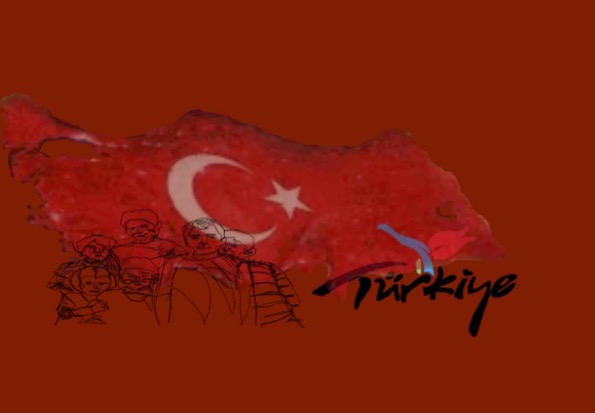
Growing up in Turkey, my love for science was sustained by magazines from the nation’s leading scientific research institute: TÜBİTAK (The Scientific and Technological Research Council of Türkiye). There has always been a lack of science resources due to the absence of scientific education in school, TV programs, or museums, and as a result, these magazines were one of few ways to be exposed to science. Today, TÜBİTAK has become another mouthpiece for the ruling party’s conservative ideology, invalidating its scientific legitimacy.
The party has a strong anti-evolutionary stance, with their former minister of education insisting that the acceptance of evolution “can only exist within atheism”, and that not teaching creationism in schools would be censorship. Since this statement, the government has banned evolutionary theory from school curriculums, and supported fabricated fossil exhibits to discredit evolution. Likewise, TÜBİTAK has increasingly adopted this anti-evolutionary stance. On the 200th anniversary of Darwin’s birthday, a planned issue featuring articles dedicated to Darwin was banned by TÜBİTAK, the articles were removed, and the editor-in-chief of the magazine was fired by the vice president of TÜBİTAK. For over a decade, every TÜBİTAK president has asserted that evolution is only a hypothesis that continues to be debated, requiring scientific encyclopaedias translated into Turkish to reflect this uncertainty. Furthermore, they halt the translation of scientific books that mention human ancestors or evolution. Evolutionary biologists receive nonexistent or restricted funding, and many are blacklisted. Fear of retaliation is so common that many Turkish academics have developed a habit of self-censorship.
Evolution is not just an arbitrary theory. During the pandemic, we witnessed evolution in real time as new variants of COVID-19 evolved and triggered new surges of cases. Modelling the evolutionary patterns of viruses is key to predicting disease dynamics, issuing proper protocol, and importantly, developing vaccines. Since COVID-19 vaccines were based on the spike protein, a region that is key for antibody recognition, any new variants that evolved mutations in this protein could evade antibodies generated for the original strain. Bivalent boosters, which contain both Omicron and the original strain, strengthen the immune response against variants. Studies have found that newer variants of COVID-19 caused more deaths than the original strain, which “has virtually gone extinct”. Thus, delivering boosters and continuing to follow lockdown protocol under the spread of new variants was essential to keeping the pandemic under control. However, viral mutations and boosters rely on a fundamental understanding of evolution. Although scientists are well-versed in evolutionary theory, the general public in Turkey is not. While the Minister of Health declared that “the third dose of [Sinovac] could be beneficial”, neither him nor the Turkish Medical Association explained the importance of boosters. In fact, he added that “there is absolutely no such medical necessity” for a third dose for those who already had two doses of BioNTech.
Lack of understanding creates anti-vaccine sentiment. In surveys conducted in Turkey, over one-third of participants had negative perceptions of the COVID vaccine, and yet this number decreased among those who had received university education. Ironically, the founders of BioNTech and the vaccine were two Turkish scientists who were raised in Germany. But because teaching evolution in Turkish schools is banned, explanations of different variants and why boosters are important are not accessible to those without a university education. Hesitation about vaccine administration is a matter of life and death.
In reality, my reason for writing this article has nothing to do with TÜBİTAK, evolution, or even COVID itself, but the recurring trend of power grabs leading to utter carelessness with human lives. As tens of thousands remain trapped under the debris following the utterly devastating earthquakes, the government is continuing to underplay the scale of the disaster. They even blocked Twitter to hide their own incompetence, even though the platform is instrumental to the coordination of rescue efforts. Rescue operations have shifted from finding survivors to recovering dead bodies. The scale of this tragedy is immeasurable, and I am struggling to communicate the extent of the pain that the people of my country feel.
Turkey has always been a hotspot for seismic activity. Geologists, seismologists, engineers, professors at prestigious Turkish universities, scientists within and outside of Turkey, and every qualified person has been warning the government for numerous years to improve the quality of the infrastructure. There have even been papers from 2017 and 2019 published on this very subject.
After an earthquake in 1999 killed over 18,000 people in Turkey, the administration at the time created a national earthquake council, pledged to improve building quality, created building-free evacuation spaces, and designated an earthquake fund from taxes. After more than 20 years of preparation, the money, which would have amounted to about £3.8 billion, has been spent on construction only benefitting the ruling party, the evacuation spaces have been sold to corrupt developers in cahoots with the government, the council dissolved many years ago, and the buildings have not seen one shred of improvement: the rubble can attest to this. Despite all the tools that science has provided to make our cities and our buildings earthquake-prepared, construction remains locked behind corruption. When science is not taken seriously, neither is the safety of people.
 Kinesis Magazine