
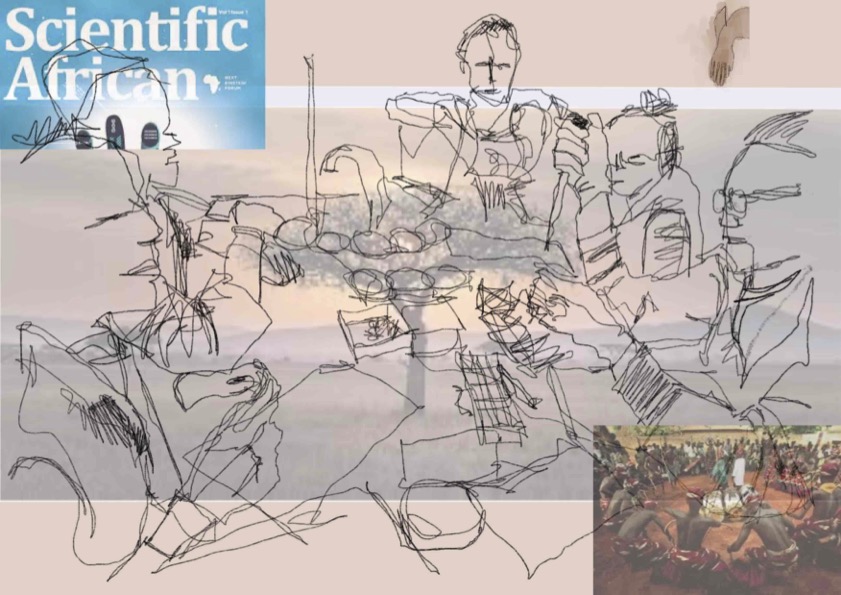
Author: Obomate Briggs
Artist: Irina Pirvu
Editor: Haytham Malik
Since the birth of modern science, the compatibility, or lack thereof, of science and religion has been the source of contentious debate. Through the dawn of the Enlightenment era, the use of meta-religious language to describe science increased, with science, in its supposed objectivity, acting as the epitome of realism. Metaphorically, religion represented the sword of Damocles to science, a looming threat and hindrance to its hierarchy and development. Various scholars have argued that the two concepts will forever be at odds, but is this legitimately true? Can science and religion ever coexist?
Much research has been produced regarding how religious beliefs can shape perceptions and attitudes towards science. However, it has primarily taken place in Western contexts and broadening our understanding of the science-religion dynamic requires consideration of how different global perspectives and cultures affect religiosity.
Africans are amongst the world’s most religious people, with members of these populations engaging with various cultural authorities such as traditional and indigenous African beliefs alongside Western religious beliefs—thereby creating a unique case to study the potential conflict between science and religion. Contrary to public opinion, new research focusing on the attitudes to science in countries such as Nigeria, Zimbabwe and South Africa has revealed that the relationship between science and religion is not such a zero-sum game.
The conflict hypothesis is one of the research paradigms used to describe the relationship between science and religion. Essentially, it reinforces the idea of an intrinsic intellectual conflict between religion and science that ultimately leads to hostility. In line with this thesis, a study investigating the relationship between science and religion in South Africa suggested the following research question: What proportions of South Africans agree that religion is always right whenever science and religion conflict?
The data showed that, in South Africa, 76% of respondents agree that religion is always right, 64% in Zimbabwe, 38% in the US and 12% in Germany. While the mean value for the importance of God in your life (religiosity) is 9.69 in Zimbabwe and 8.08 in South Africa, comparatively to 4.41 (lowest) in Germany. Nevertheless, results show that the influence of religiosity on the conflict variable is significant across the four countries but is much stronger in Germany and the US than in African countries. Findings reported from this quantitative approach are, somewhat, in line with the often-stated conflict narrative. However, this is limiting as it is formulated to foster the conflict narrative. It is biased through its binary choices of ‘Agree’ or ‘Disagree’, forcing the respondent to disregard the dynamic subtleties of the science-religion relationship.
This outright rejection of one or the other is an assumed response to our ‘cognitive dissonance’; the perception that these supposedly conflicting concepts make us ‘psychologically uncomfortable’, that we yearn for our minds to be in accord with our existing knowledge. An expression of this state can also lead to hierarchical beliefs, the elevation or demotion of religion (or science) relative to the other, which offers a more nuanced perspective through some form of coexistence. This was further explored through the qualitative analysis of the South African study, in which semi-structured face-to-face interviews were conducted using open-ended questions. For example, researchers asked the question: ‘Are there ways in which scientific knowledge conflicts with your beliefs (such as faith or religion)?’, qualitatively elaborating on the previous question.
The qualitative study shows some respondents did not feel any psychological discomfort, debunking the supposed universality of the dissonance theory. Rather, they seemed comfortable living with both forms of knowledge, either in a parallel (i.e., addressing different aspects of life) or in a complementary relationship (i.e., one enhances the experience with the other). Or, alternatively in a transformative relationship in which they both transform each other through the ability to be ‘weigh[ed] against the other’.
According to psychologist Moscovici, this phenomenon is s a display of cognitive polyphasia where different forms of knowledge possessing different rationalities live side-by-side in the same individual or group. Having faith in both forms of knowledge was also found in Nigeria, a fellow African country where most respondents expressed similar levels of faith in science and religion.
Although 88% of Nigeria’s 174 million population agree that religion is always right, cognitive polyphasia was prevalent in this research, particularly in the statistical interaction of scientific knowledge and religion when considering evaluative attitudes to science. Like the results found in South Africa, it defines cognitive polyphasia into three categories: hierarchical, complementary but parallel, and empowering. On both ends of the religious spectrum, individuals engaged with science and religion with differing consequences. Those with high religiosity were in shock and awe of science, alluding to the complementary cognitive polyphasia, in which the wonders of the physical world reflect a wondrous God. The more conventional believers were more realistic, less optimistic, and less fearful about science as their knowledge increased.
Of note are the variable dimensions that require acknowledgement of their effects on the interaction between science and religion and how this can differ culturally, such as the social aspect. In South Africa, social trust is a discriminator between African countries and more advanced economies, whereas increased education, as seen across these countries, is a negative predictor of the conflict hypothesis. While in Nigeria, there is evidence of cognitive polyphasia in patterns of trust in different actors. Therefore, those who trust the scientist will also trust the religious leader and, to some extent, other state actors but not politicians.
There is a heightened need for more research into the relationship between religion and science in Africa and other non-western countries, as studies support the idea that cultural differences may exist within this interaction. Our understanding of the complex problem of science and religion in Africa is advanced by such studies, particularly the South African study that integrated two different approaches: the quantitative and the qualitative. Thus, highlighting a discrepancy in the narrative between the scholarly popular conflict thesis and people’s true, regular interactions with science and religion.
So, can science and religion ever coexist? It appears as though they already are.
An individual can, at times, express the different knowledge forms by professing faith in the two statements of ‘truth’ in the same context. This research suggests that faith in science is not necessarily radically different from religious faith. They are, after all, driven by the same concept.
 Kinesis Magazine